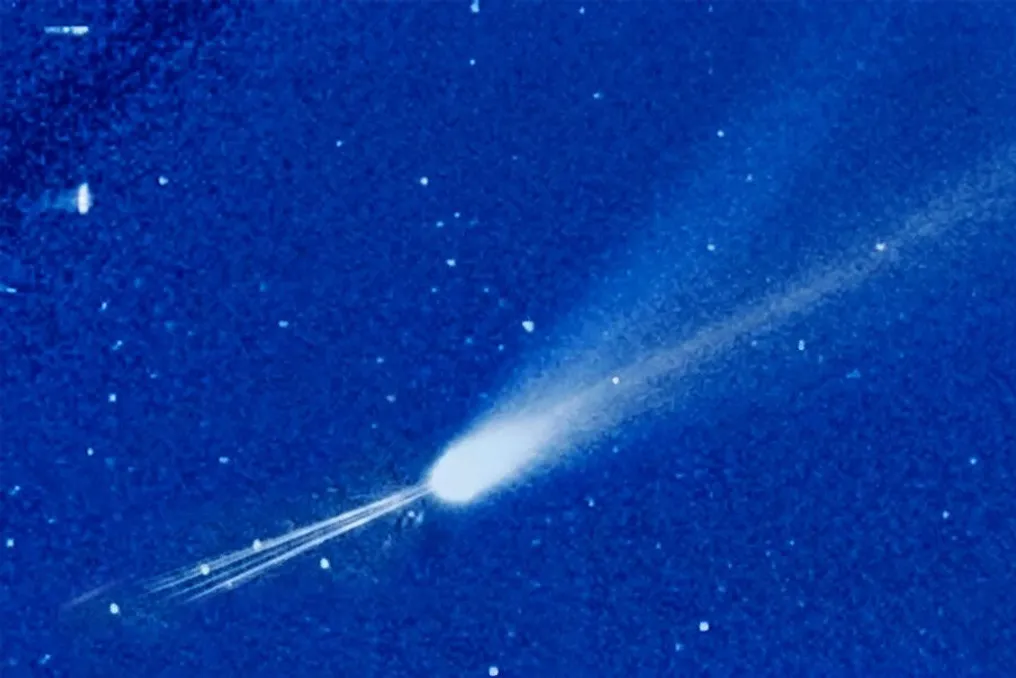
A comet with approximate dimensions of ten kilometers, comparable to the asteroid linked to the dinosaur extinction, is about to make its most advantageous approach to Earth over several decades. Comet 10P/Tempel 2, which was identified 153 years ago, can already be observed with binoculars or a small telescope starting this month.
Approach Details
On August 3, 2026, during its closest point of approach, the comet will be only 0.4144 astronomical units (AU) from Earth, which is equivalent to about 62 million kilometers. It is worth remembering that one AU represents the average distance between the Earth and the Sun.
Discovery and Orbital History
The initial observation occurred on July 4, 1873, when German astronomer Wilhelm Tempel noticed a faint body moving southeast in the constellation Pisces. He monitored it the next day and continued tracking the object until October 20, when it left the field of view.
The first calculations, based on the recorded trajectory, suggested an orbital cycle of 5 or 5.5 years. However, after Tempel observed the comet's return on July 19, 1878, the estimate was refined to 5.16 years. Currently, it is known that the actual orbital period is 5.37 years. The orbit of 10P ranges from a point slightly inside Jupiter's orbit to a point near Mars's orbit.
Due to this relatively short cycle, 10P is a frequent observation target; however, not all passages offer ideal visibility conditions. A scientific article points out that although telescopic advancements allow it to be seen during each appearance, the interval of about 5.5 years causes appearances to alternate between favorable and unfavorable geometries for observation.
Past and Present Visibility Conditions
The same study details that the comet was well positioned in 1978, 1988, and 1999, but showed poor positioning in 1983, 1994, and 2004, moments when it reached perihelion on the side opposite the Sun relative to Earth. The predicted passage for 2026 falls among those considered favorable.
As it approaches and heats up near the Sun, the comet undergoes sublimation of ice and gas, which modifies its composition. Researchers who have tracked 10P over time have detected that its rotation has considerably decreased, a phenomenon attributed to asymmetric outgassing, the process by which the comet releases material irregularly while heating and cooling in its orbit.
The five-year orbital period and the proximity of 10P made it a focus for space mission proposals that were not realized. Among them was a suggestion to reuse the Mariner 3 probe, belonging to NASA. To date, no mission has been sent to study the comet up close.
Observation Guidelines
Starting this month, the comet will be visible in the constellation Capricornus for those with binoculars or a small telescope. The best viewing conditions are expected near perihelion, that is, the point of maximum approach to the Sun, when its brightness should reach magnitude 7, passing near the constellation Piscis Austrinus.
Although the comet is visible to observers in both hemispheres, it will appear significantly higher in the sky for those located in the Southern Hemisphere.