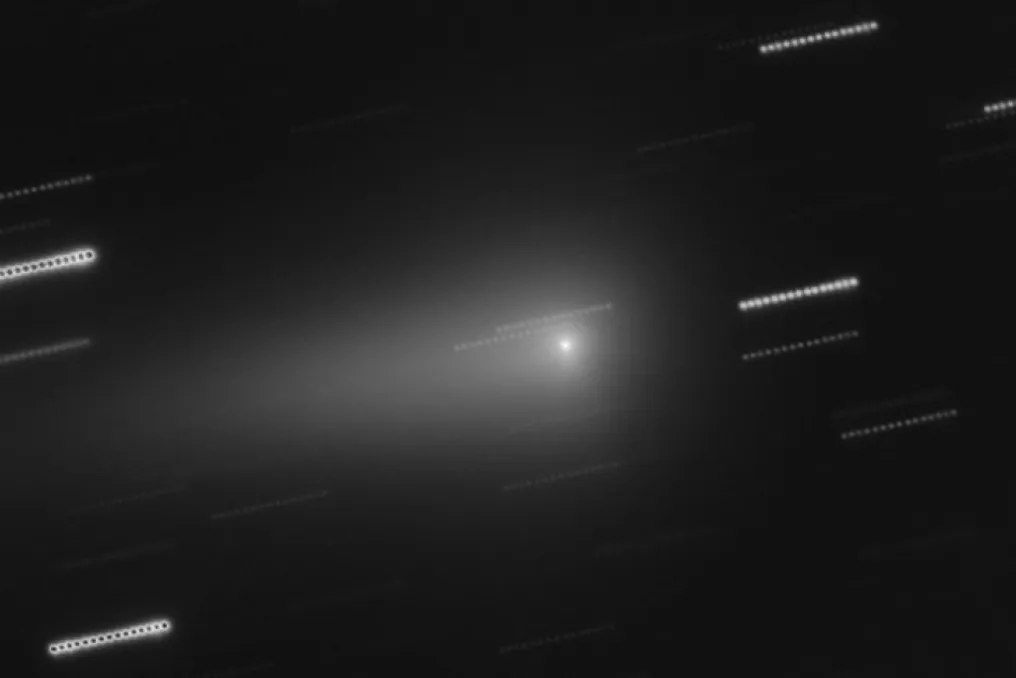
Researchers assessed the nitrogen and carbon isotope content in the nucleus of comet 3I/ATLAS. According to this data, the comet likely formed in the cold outer region of a protoplanetary disk around an old star that is characterized by low metallicity in the Milky Way.
Popular
Comet Discovery and Characteristics
Comet 3I/ATLAS was discovered in July 2025 and is the third confirmed interstellar object to pass through the Solar System. Such celestial bodies provide the scientific community with a unique opportunity to study the chemical composition of protoplanetary disks around other stars and compare it with the material of small bodies in our Solar System.
The analysis showed that comet 3I/ATLAS contains significant amounts of methanol, carbon dioxide, and deuterated water. Combined with data obtained from studying the comet's trajectory and kinetic characteristics, scientists suggest that its age may range from 7.6 to 12 billion years, and its origin is linked to a star with a thick disk in the Milky Way.
Research Methodology
A group of astronomers led by Siriel Opitom from the University of Edinburgh published the results of measuring carbon isotopes (12C and 13C) and nitrogen isotopes (14N and 15N) in the comet's coma. This data was compared with information on Solar System comets and protoplanetary disks around other stars.
Observations of 3I/ATLAS were conducted from December 6 to December 26, 2025, using the UVES échelle spectrograph installed on the VLT telescope complex. The main goal of these observations was to study CN molecules in the comet's coma.
Analysis of Isotopic Ratios
Changes in the ratios of carbon and nitrogen isotopes in different regions of a protoplanetary disk can be caused by molecular photodissociation under stellar radiation and isotopic exchange reactions, which provides additional information about the comet's formation site.
For 3I/ATLAS, the ratio of 14N to 15N was 343. This value is significantly higher than the average value for Solar System comets (about 150) and exceeds the value for the interstellar medium (about 274). Nevertheless, it falls within the ranges characteristic of pre-stellar cores and protostars (from 150 to 400) and is lower than the solar value (about 458).
The ratio of 12C to 13C reached 147, which is also higher than the average figures for Solar System comets (about 90) and the interstellar medium.
Conclusions on Comet Origin
The observed picture aligns with the model that 3I/ATLAS originated in the outer, cold part of a protoplanetary disk (temperature below 30 Kelvin) around an old, low-metallicity star. In such an environment, the photodissociation of nitrogen molecules occurs weakly, and the decrease in 13C content is attributed to both low metallicity and isotopic exchange reactions.
However, the measured nitrogen isotope ratio does not allow for a precise determination of the parent star type or a specific region of the Milky Way, as the difference in values and uncertainties recorded for various star-forming regions of the Milky Way are too large.
Additional Discoveries
It is also worth noting that astronomers discovered the super-Earth Ross 318, located very close to Earth and almost in the middle of the habitable zone of a red dwarf. This planet has sufficient mass to maintain a noticeable atmosphere and is characterized by a moderate temperature. A preprint of this work is available on the arXiv.org website.