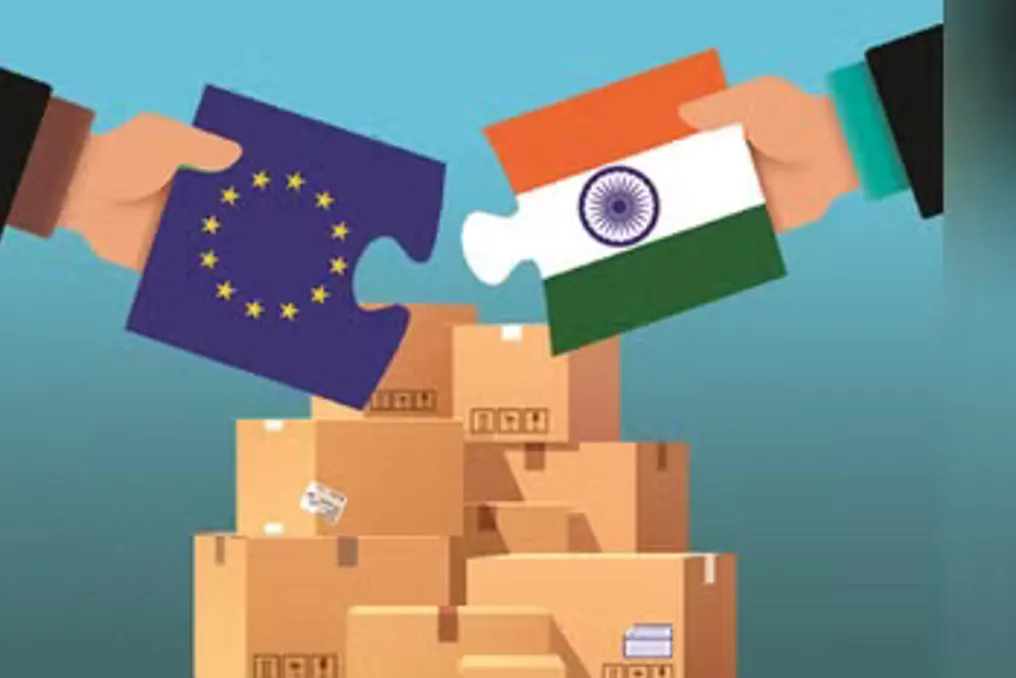
According to the European Commission's chief negotiator, the free trade agreement between India and the European Union (EU) is likely to enter into force in the fourth quarter of 2027 following its ratification.
Projections for Entry into Force
Christoph Kinner, Deputy Director General of the Directorate-General for Trade and Economic Security of the European Commission and the lead negotiator for this trade deal, stated that with favorable developments, the agreement could come into force around the second quarter of next year or, at the latest, by early summer.
Previously, leaders and officials from both sides had repeatedly expressed confidence that the deal would be signed by December of this year. Kinner also confirmed that the agreement would be signed before the end of this year.
Differences in Implementation Timelines
However, the timelines stated by Kinner differ somewhat from the forecast of Trade and Industry Minister Piyush Goyal, who expects the deal to launch by March of next year. Kinner added that informal sessions will be scheduled for members of the European Parliament in the autumn to clarify the terms of the trade agreement, which may accelerate the ratification process.
Ratification Process and Future Meetings
The trade agreement requires approval from the European Parliament, whereas in India the process is simpler, requiring only the approval of the Union Cabinet followed by assent from the President. Minister Goyal, Foreign Minister S. Jaishankar, and Minister of Electronics and Information Technology Ashwini Vaishnaw plan to visit Brussels next week to hold a dialogue within the India-EU Trade and Technology Council (TTC), which is intended to supplement the trade agreement and promote its implementation.
Details of the Trade Agreement
Kinner reported that after the deal is finalized, both parties are working on the legal refinement of the agreed text, which, according to him, they plan to complete by the end of this month. The parties often refer to this deal as the 'mother of all deals.' Under the agreement, India has provided tariff concessions on 86 percent of product lines, while the EU has offered liberalization on 97 percent of lines.
According to Kinner's assessment, EU exporters will save about 4 billion euros on customs duties. He noted that India has traditionally been an economy with high tariffs, but the FTA provides for reducing tariffs to zero in several sectors. For example, the duty on machinery and electrical equipment will decrease from a maximum of 44 percent to zero. Furthermore, tariffs on aircraft and chemicals will drop to zero from previous levels of 11 and 22 percent, respectively. Regarding motor vehicles, the tariff quota will bring rates to 10 percent at the end of the transition period, down from up to 110 percent.
Benefits for Indian Sectors
Darpan Jain, India's chief negotiator and Additional Secretary of the Ministry of Commerce, who was also present at the discussion, stated that labor-intensive sectors in India, such as textiles and apparel, leather, marine industry, chemical products, and plastics, are likely to benefit from the trade agreement with the EU.