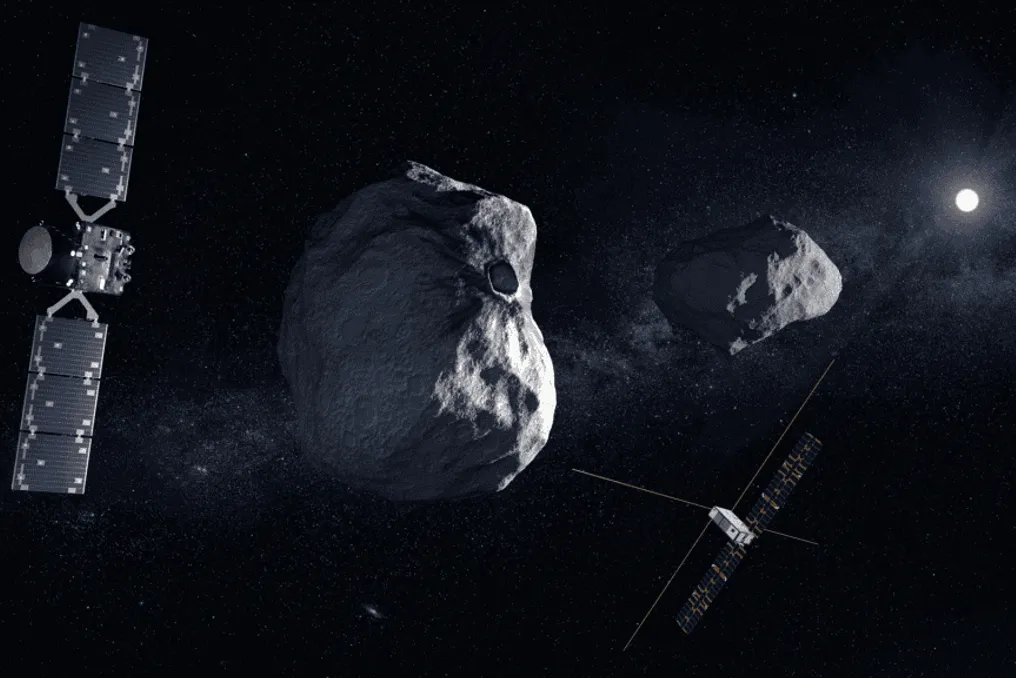
The European Space Agency (ESA) has completed a crucial phase of the Hera mission by updating the spacecraft's software intended for the study of the asteroids Dimorphos and Didymos. This procedure was conducted remotely, as the craft was already on a trajectory in deep space.
Remote Operation and Technical Challenges
The mission control team, based at the European Space Operations Centre (ESOC) in Darmstadt, Germany, executed the update by sending commands via space communication. This achievement was made despite the challenge of managing a vehicle located approximately 140 million kilometers from Earth.
With the new system, the Hera spacecraft will be able to utilize its autonomous navigation capabilities, test its remaining instruments, and establish contact with two small satellites that will be released during the mission. This update prepares the craft for the approach and analysis phase of the targets.
Mission Preparation and Testing
Implementing the new software required a series of meticulously planned tests and procedures. Since Hera was already traveling at over 12 kilometers per second, the personnel did not have physical access to the equipment, necessitating remote instruction via 35-meter communication antennas.
After sending the commands, the team performed two reboots of the onboard computer. The system uses parallel processors designed to ensure redundancy, allowing for the isolated evaluation of each component before resuming full operations.
Anna Schiavo, Hera operations engineer, clarified that this update marks the final preparation of the craft for the asteroid phase, as the software will enable the activation of pending instruments and autonomous systems essential for the exploration of celestial bodies.
Before launch, the program underwent an extensive validation campaign at ESOC, which lasted about a year and a half. This campaign included 50 days of ground activities and navigation simulations around the asteroids, as well as interaction with the CubeSats that will accompany the mission.
Sylvain Lodiot, responsible for ESA's planetary defense and outer solar system operations, reported that the tests were conducted using a functional replica of Hera at the company OHB, located in Bremen, Germany. This equipment simulated flight scenarios, asteroid models, and communication between the main spacecraft and the small satellites.
Caglayan Guerbuez, spacecraft operations manager, noted that Hera was launched in October 2024 without the final software version due to dependence on a specific window to take advantage of a close pass near Mars. A delay in the launch could extend the arrival at the destination by several years.
Scientific Objective of the Hera Mission
Hera is ESA's first planetary defense mission and focuses on the asteroid Dimorphos, which orbits the larger body known as Didymos. Scientific interest in this system arose after an unprecedented human intervention in space.
In September 2022, the DART spacecraft, belonging to NASA, collided with Dimorphos, resulting in an alteration of its orbit. Although this event was monitored by ground telescopes, the detailed impacts of the collision on the asteroid's surface and structure are still unknown.
The Hera mission will conduct a detailed inspection of the affected area to investigate the consequences of the impact, thereby transforming the kinetic impact experiment into a clearer model of planetary defense. The ultimate goal is to increase knowledge about possible response methods should a space object pose a future threat to Earth.