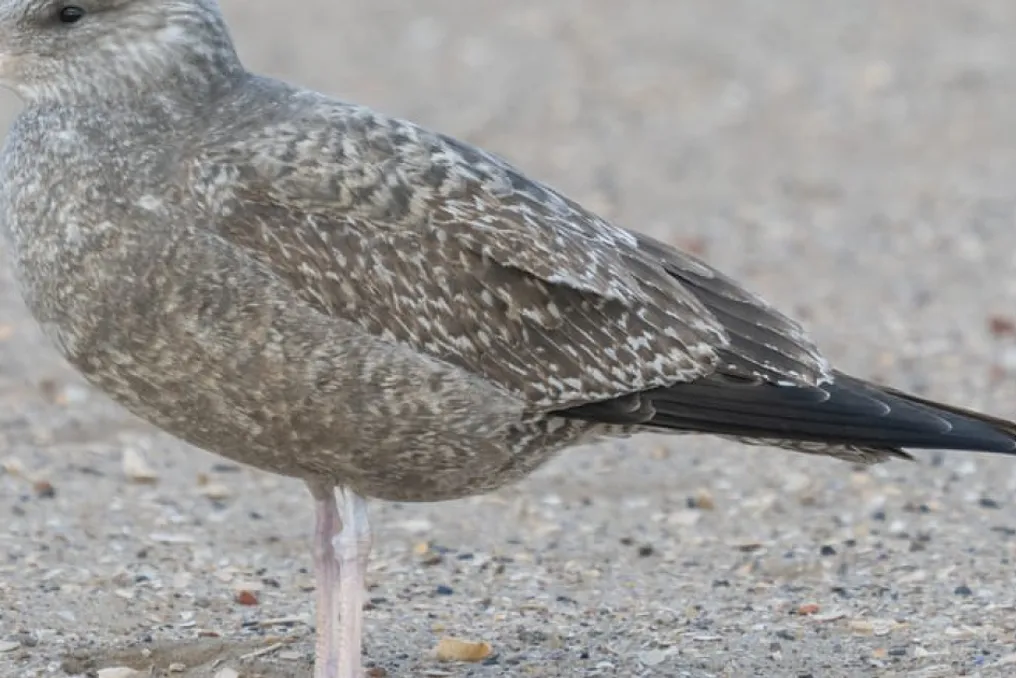
Ornithologists have established that the brown color of the plumage serves as protection for young gulls, preventing aggression from adult birds. This conclusion was reached after analyzing the results of experiments conducted on Kent Island.
Ornithologists have established that the brown color of the plumage serves as protection for young gulls, preventing aggression from adult birds. This conclusion was reached after analyzing the results of experiments conducted on Kent Island.
American gulls from the local population demonstrated a lower aggressive reaction to a model simulating a first-year relative compared to the reaction to a model with adult coloration. It is hypothesized that this protective coloring allows juveniles to safely visit nesting colonies where they acquire skills related to reproduction and territorial behavior. The research findings were published in the journal Animal Behaviour.
Gulls of the genus Larinae, with rare exceptions, have white plumage with gray wings, and some species may have black, brown, or gray heads. However, this coloration is only acquired by individuals who have reached sexual maturity, which can take two or more years depending on the species. Immature birds look different: in their first year of life, they typically have plumage with numerous brown speckles, and later they acquire a coloration similar to adults but with fewer speckles.
Although the reason for such significant differences between gulls of different ages remains unclear, ornithologists hypothesize that the brown coloration helps young individuals signal that they have not yet reached sexual maturity. This, in turn, means they do not pose competition to adults regarding mate searching or nest territory acquisition, allowing them to avoid aggression. A similar protective mechanism based on external differences has previously been observed in other animals, including orangutans (Pongo) and certain passerine birds and fish.
A team of ornithologists led by Molly Hill from the Boding research station tested this hypothesis on Kent Island, located in the Bay of Fundy in northeastern North America. Approximately 6,000 American gulls (Larus smithsonianus) nest on this island annually. During the 2023–2024 period, Hill and her staff conducted an experiment by placing plastic models of relatives near nests (which already had two or three eggs). These models could simulate a non-mature first-year individual (with numerous brown speckles), a non-mature third-year individual (with coloration approaching adult but with brown speckles on the wings), or an adult older than 46 months. A Canadian goose (Branta canadensis) model was used as a control group for comparison. After setting up the models, researchers drew the gulls' attention with sounds from a speaker and recorded their reaction for two minutes. Over two seasons, 120 nests were tested, and the owners of each were shown all four types of models.
In 67 percent of cases, the gulls did not react aggressively to the model; they either ignored it or showed signs of unease and emitted corresponding cries. However, in 33 percent of cases, aggression was observed: the birds displayed territorial defense behavior, attempted to attack the model with their beaks, or swooped down on it from the air, sometimes engaging in physical contact, such as pecking. According to scientists, the model of a sexually mature relative most frequently provoked an aggressive reaction. The probability of aggressive behavior towards the first-year gull model was 48 percent lower (p < 0.05), while for the goose model, this probability decreased by 86 percent (p < 0.001). The third-year gull model caused aggression with approximately the same probability as the adult relative model. Furthermore, the degree of aggression shown towards the first-year individual model was lower than towards the sexually mature individual. When considering only aggressive instances, the first-year gull model elicited the maximum level of aggression slower than the sexually mature bird model (averaging 43.9 seconds versus 36.7 seconds).
The data obtained confirm the hypothesis that the brown coloration of young gulls serves as protection against attacks by adults, as American gulls react less hostilely to first-year relatives than to sexually mature ones. The authors suggest that this may be related to the fact that such coloration resembles chicks. Thanks to this protection, immature gulls can freely visit nesting colonies to acquire skills related to reproduction and territorial behavior. Nevertheless, it remains unclear why third-year gulls, which constitute about four percent of the total colony population on Kent Island, do not have this protective brown coloration. One theory suggests that their coloration may serve as a signal not to older, but to younger relatives with whom they meet at resting and feeding sites. Another theory posits that their coloration also reduces adult aggression, but the experimental design did not allow confirmation of this effect.