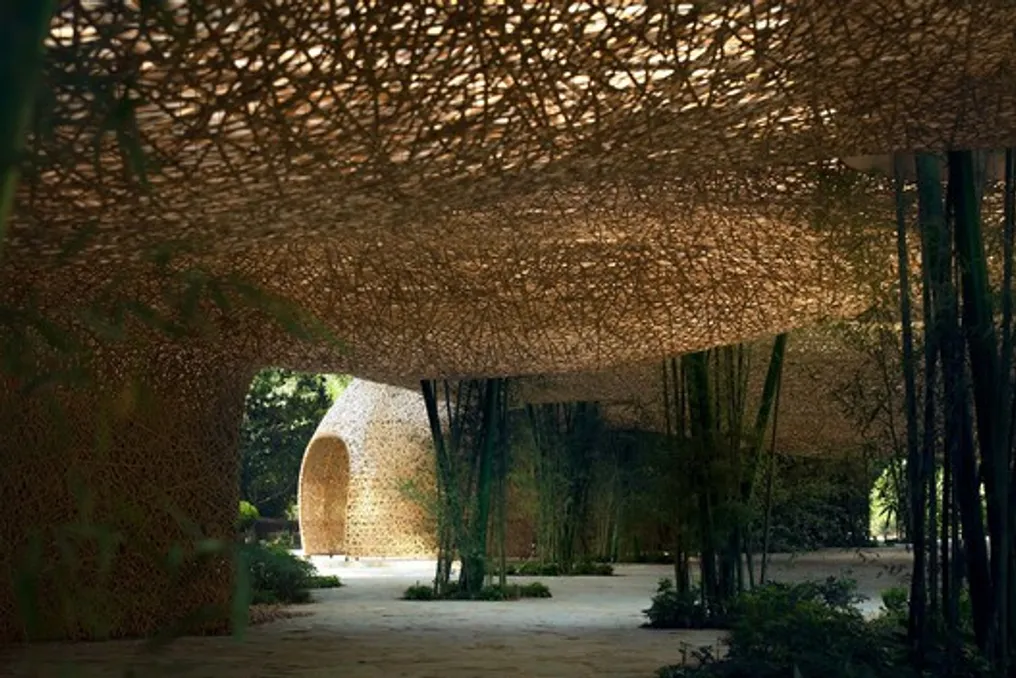
Bamboo is often praised before it is fully understood. Due to its rapid growth, it has a vast history in construction cultures and seems to offer architecture an immediately ecological language. In images, its logic appears self-explanatory: light, natural, renewable, and aligned with a more sustainable future. However, this apparent simplicity is what complicates precise discussion about bamboo. By being elevated to a symbol of environmental responsibility, the material risks being overshadowed by the image it projects.
Idealization Versus Material Reality
This scenario reflects the risk of bamboo's contemporary resurgence. It can easily be idealized as an ecological substitute for industrial materials, a regional expression, or a softer alternative to the rigid standards of steel and concrete. In all these contexts, bamboo is admired before its actual conditions are grasped. The central question is not whether bamboo is generically sustainable, but rather what kind of architectural culture it demands: what knowledge, maintenance, regulation, labor, and time are necessary for its sustainability to materialize.
Bamboo transcends the function of mere material awaiting specification; it is a plant that architecture attempts to convert into a product. Unlike standardized wood products, the natural culms of bamboo maintain their biological variability. They taper along their length, exhibit variations in wall thickness, react to humidity, and require meticulous planning for harvesting, drying, treatment, and assembly. Even after being incorporated into the building, bamboo continues to interact with climate, pests, maintenance, and use. Thus, working with this material implies accepting a longer and less malleable life cycle, which begins long before the construction and extends well after the apparent completion of the building.
Dialogue Between Craftsmanship and Industry
At this point, bamboo directly dialogues with the concepts of transspecies architecture and the life of materials. It positions itself between vernacular artisanal making and industrial standardization, between rural economies and the current debate on carbon, traditional knowledge, and new forms of certification. It requires architecture to translate living matter into structural responsibility, without pretending that the material's life has ceased. Bamboo holds political relevance not because it offers a simple solution to modern construction, but because it highlights the difficulty of architecture in managing materials that grow, vary, require care, and resist total control. Its political dimension, therefore, encompasses knowledge, maintenance, and time.
From Natural Culm to Industrial Product
Modern construction relies on materials that can be made predictable. Steel, concrete, glass, and aluminum are not simple materials; they circulate through the construction industry with a high degree of legibility. They can be ordered, calculated, transported, insured, and certified by systems that already know how to interpret them. Upon arrival at the site, they are already fully translated into the language of contemporary construction.
Bamboo resists this translation. A natural culm cannot be treated as an abstract line in a structural diagram, given that its behavior is linked to its growth process. Unlike standardized wood products—which have undergone extensive processing, classification, and have been assimilated by current construction systems—bamboo often retains its biological irregularity. Even engineered bamboo products do not yet occupy the same industrial or regulatory niche as engineered wood. Consequently, bamboo cannot merely be chosen as a neutral option; its variability is integrated into the very challenge of the design.
The obstacle lies in the fact that contemporary architecture tends to recognize the intelligence of materials only when they become predictable. It is easier to trust a material when it can be cataloged, specified, and inserted into known purchasing and calculation systems. Bamboo challenges this process because its architectural value depends, in part, on the variations that industrial systems seek to eliminate. The problem is not bamboo's lack of rigor, but rather that this rigor needs to be defined differently: less by suppressing variation and more by the discipline of understanding how to work with it.
Tension Between Craft Knowledge and Standards
This tension manifests in the difference between natural bamboo culms and engineered bamboo products. Laminated sheets, panels, and structural elements facilitate the integration of bamboo into the construction industry because they behave similarly to conventional materials. However, this legibility entails a change: bamboo becomes less visibly a plant and clearly acquires the identity of a product. Neither situation is inherently more authentic or ecological; what matters is that each carries a distinct policy. Natural bamboo requires architecture to work with irregularity, while engineered bamboo raises a more complex question: how much transformation, energy, and industrial correction must a plant undergo before the construction industry trusts it?
Bamboo also destabilizes the usual hierarchy of construction knowledge. In many current systems, authority flows from design to specifications, and then to contractors, suppliers, and professionals on site. It is expected that the material will arrive exactly as described and function as promised. Bamboo complicates this hierarchy because much of the knowledge about it resides in proximity to the material itself, belonging to those who have learned, in practice, how bamboo grows, cracks, bends, ties, and breaks. Since this knowledge is difficult to translate into a single formula or universally accepted method, the practice with bamboo is often labeled as informal or non-standardized. This does not make it less technical; it simply means its intelligence is transmitted through discernment, repetition, and direct contact, and not just through calculation.
This implies that bamboo carries a different kind of risk. Without widely accepted parameters, standardized classifications, and shared verification methods, its performance depends much more on execution, inspection, and maintenance. Bamboo may allow for more local adjustments, but it also presents a greater margin for human error. The question is not whether bamboo is intrinsically safer or more dangerous than steel, but rather that its risks are structured differently. In temporary or repairable uses, its vulnerabilities appear through loosening, cracking, displacement, or deterioration—signs that demand constant attention, not passive trust. Thus, its policy of flexibility cannot be dissociated from a policy of care.
This is not an argument against steel, nor a romantic defense of informality. Predictability is crucial, especially when there are issues of safety, scale, and public responsibility. However, bamboo helps reveal another construction ethic. It suggests that material intelligence does not need to reside only in the factory, in the specification, or in the calculation model; it can also belong to those who plant and cultivate, to treatment specialists, to scaffolding masters, to carpenters, and to those who understand the material through direct contact.
A more coherent bamboo architecture must transition between inherited artisanal knowledge and contemporary regulation. It is necessary to integrate engineering without allowing certification to become the sole recognized form of intelligence. This is not a contradiction to be resolved, but a condition to be worked on. Bamboo is important because it forces architecture to confront the abyss between what the construction industry easily measures and what construction knowledge truly demands.
Carbon and the Politics of Time
Although bamboo may be less structurally predictable than steel, it can be more accurate in another aspect: it understands that cities do not always operate at the pace of permanence. Much of current construction still adopts the language of durability, even when the programs it houses are transient. Stores change, exhibitions are relocated, interiors are renovated, and public spaces are reconfigured long before the carbon invested in them has time to be compensated. In this context, the bamboo policy is also a policy of time. It questions whether every architectural problem must be solved with materials that presuppose a static and distant future.
Steel and concrete remain potent by promising durability, resistance, and control. However, when applied in provisional or constantly remodeled areas, their material intensity can be disproportionate to their actual urban lifespan. Bamboo suggests a different calibration between material commitment and architectural duration. Its strength-to-weight ratio, growth speed, and relative lightness do not make it universally superior, but they make it ideal for structures that anticipate change: spaces that can be assembled, repaired, adapted, dismantled, and rebuilt without the expectation that every need will become permanent infrastructure.
This also exposes a flaw in how building codes conceive of time. In many regulatory systems, the distinction between permanent and temporary constructions is treated primarily as a matter of shorter duration or lighter requirements, rather than as a project category with its own architectural intelligence. However, temporality should not mean informality or reduced safety. It should demand a distinct type of rigor: clear limits of use, inspection cycles, maintenance responsibilities, replaceable components, and dismantling or renewal protocols. For bamboo, this differentiation is vital. Its value lies not in evading regulation, but in fostering norms that support safe forms of transformation.
In summary, the question is not whether bamboo can replace steel or concrete—it cannot, and it should not be required to. The most pertinent inquiry is where architecture has used permanent materials to solve temporary problems. Bamboo gains relevance in these gaps by offering a material logic closer to repair than to definitive character. Its political dimension resides not only in the speed of its growth or the amount of carbon it stores, but in the distinct perception of time it proposes to architecture: a vision where the act of building is not a singular gesture of control, but a continuous relationship between material, maintenance, use, and renewal.
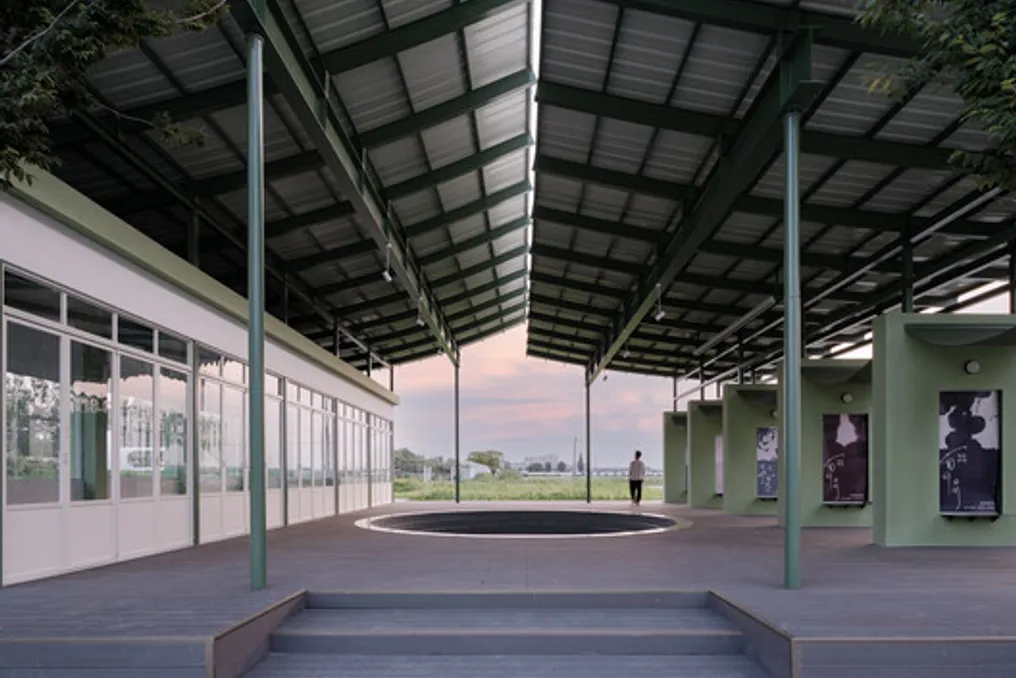
The project is a micro-gallery designed for rural life, implemented in a Chinese rural community in Jiangsu Province. The pavilion is situated within a landscape characterized by grape cultivation, canals, and agricultural fields.
Concept and Purpose of the Project
This structure is conceived as a recreational area and a small exhibition gallery intended to showcase the local culture and regional agricultural products. Its design is inspired by the geometry of the cultivated fields.
Integration into the Landscape
The pavilion is delicately placed near water bodies, forming a public space for interaction. Thus, the project combines elements of scenery, agriculture, and the life of the local community.
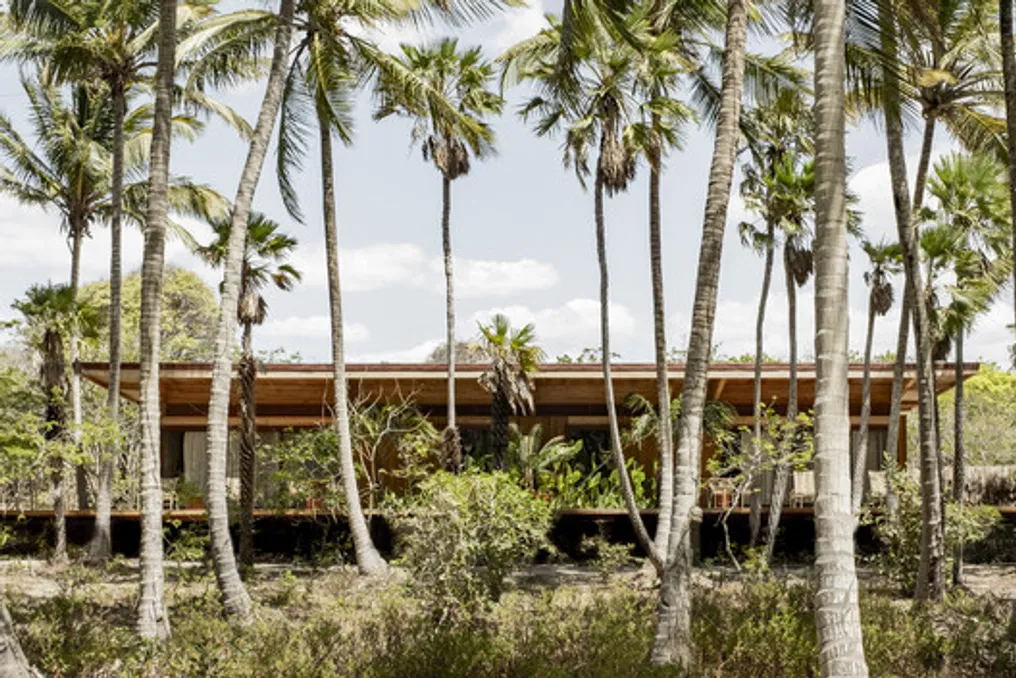
Four wooden modular bungalows have been implemented at Casa Daia in Barra dos Remédios, on the west coast of Ceará, a boutique hotel inaugurated in 2025. This project demonstrates how industrialized construction can coexist with high-quality architecture in an ecologically sensitive territory.
Casa Daia is located on a former 220-hectare farm, an area that hosts mangroves, dunes, riverbanks, Caatinga, and coastal forest.
To minimize impact, extensive environmental zoning studies were conducted, and the units were installed in pre-existing clearings without suppressing vegetation. The Modular BV construction system, developed by UNA Barbara and Valentim in partnership with Crosslam, uses prefabricated modules made of eucalyptus reforestation CLT, which are assembled dry on site. This approach not only drastically reduces implementation time and waste but also integrates elements such as balconies and large openings to optimize natural light and cross-ventilation. Furthermore, the project promotes dialogue with neighboring communities of Pescada Nova and Praia Nova, prioritizing local labor and sustainable practices such as rainwater harvesting and photovoltaic energy.