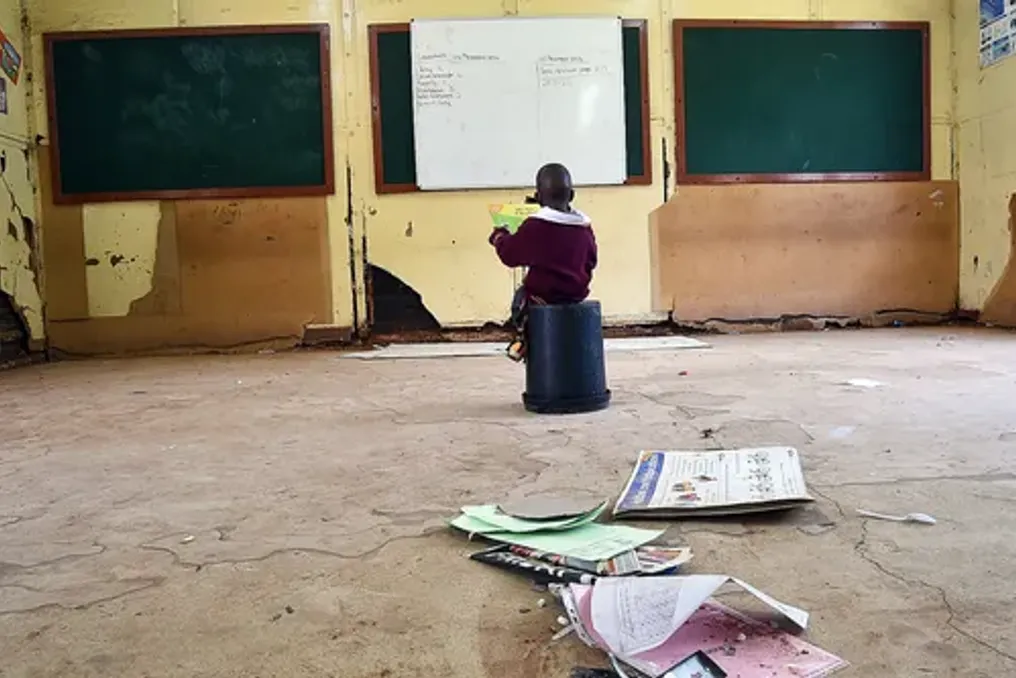
The public education system in South Africa has been undergoing a severe decline over the past decade, with the majority of schools—specifically 85%—considered largely dysfunctional. Despite the government increasing educational access—reflected in a 222.4% rise in Grade R enrollment over the last 25 years—the overall quality of education has decreased.
Furthermore, only 63% of students who start their studies complete their matriculation certificate. However, graduating from high school does not guarantee future success, as many graduates are unable to enter university, which limits their ability to make a significant contribution to the economy.
Economist Dr. Azar Jamin noted on the recent podcast Palatable Politics that many students entering universities are unlikely to ever become productive members of the modern economy. He emphasized that the low quality of basic education leads youth to avoid studying fields where jobs are created and where they are truly needed.
Jamin added that the situation will become even more critical as the economy becomes increasingly digital, based on mathematics and computer technology. He explained that South Africa's fastest-growing economic sectors rely heavily on mathematics, which includes not just calculation but also logical information processing. The expert expressed regret that the country's education system does not adequately develop these skills, noting that most of the problem lies in primary education rather than universities.
He also stated that 'Eighty-five percent of South African schools are largely dysfunctional,' and that the country is 'fortunate that 15% excellence is provided by private and Model C schools.' According to experts and education researchers, out of 24,000 South African schools, only about 4,000 are truly capable of nurturing qualified professionals.
Last year, the Department of Basic Education (DBE) reported that 464 public schools do not teach mathematics to their students. The department clarified that students must choose academic streams in Grade 10 according to their interests and future career plans. It was also stated that while mathematics remains a priority subject, schools may lack sufficient resources or demand to offer both mathematics and mathematical literacy.
The organization BOSA stated that the education crisis in South Africa is caused not by a lack of funding, but by poor prioritization, weak oversight, and low expectations. This party presented a 10-point plan to address this issue:
A Bosa representative further explained that their vision for education reform is bold and transformative. It includes establishing an independent ombudsman for education, increasing teacher salaries, implementing a student voucher program, and conducting a nationwide audit of teacher skills. They believe that primary education must be prioritized, students encouraged, and every rand of the 300 billion education budget spent effectively.
South Africa spends a significant portion of its budget on education, allocating about 6% of the country's GDP annually. The country ranks among those with the highest expenditure on education relative to its economy, yet demonstrates some of the lowest results globally. Jamin noted that the government already allocates a high proportion of the budget to education, but these funds are being spent inefficiently.
Most of these funds go to administrative staff in state and provincial departments, rather than to teachers and educational resources. Despite significant government spending, only a small fraction reaches the classroom to improve student outcomes. Former Finance Minister Trevor Manuel pointed out that a key problem in South Africa is a lack of understanding of what educational transformation truly means. He observed that existing educational policies have failed to dismantle the two-tiered system where high-quality education areas coexist with regions of generally lower standards.
Manuel stressed: 'It is a huge achievement that 80% of schoolchildren in South Africa attend free schools. But the absence of fees often also means the absence of mathematics, science, and discipline.' He reminded that 'Bantu education was built in the 1950s without mathematics. That was in 1953, and in 2025 mathematics is still absent.' He concluded that 'You have deprived a generation of students and subsequent generations of teachers of quantitative skills, and that is why it is still missing.'
Dr. Oninye Nwaneri, CEO of Sesame Workshop International South Africa, indicated that child poverty is also a serious factor disrupting early educational development. Nwaneri referred to the 2024 South African Early Childhood Review report, which states that nearly two-thirds of children aged 0 to 5 live in the 40% poorest households, and approximately 1.3 million children aged three to five lack structured early learning opportunities. This indicates that while the Constitution sets a vision for child well-being, the systems supporting early development are not as strong a constitutional foundation as they should be.
School principals in South Africa are expressing serious concern regarding the burdensome administrative load caused by outdated management practices. According to the report, the education system stifles leadership qualities due to an excess of paperwork, and a genuine dialogue is needed to transform the accountability system into an empowerment tool.
The National Report by the Governance Board Fund (GBF) on the workload of public school principals should not be viewed merely as another educational survey, but as a distress signal from the people who are supposed to support schools. According to this report, 84% of principals regularly work after hours to cope with administrative demands. Furthermore, 92% stated that the administrative burden has increased or significantly increased compared to five years ago.
Moreover, 71% note the negative impact of this burden on their ability to perform their core duties as school leaders, and 59% believe the strain forces them to seriously consider leaving their positions. The principal is the backbone of the school, as the atmosphere of care, discipline, and safety created by the leadership directly affects the institution's academic performance and the decision of young teachers to stay or leave the profession.
When nearly six out of ten school leaders are considering resigning, the government should review its own systems rather than demanding new reports. The most alarming aspect is not the principals' employment itself, as leading a school has always required long hours and strong dedication. The problem is that a significant portion of this time is now spent filling out forms, re-compiling reports, maintaining files, responding to urgent requests, duplicating information, and complying with requirements.
Many principals spend overtime not developing better pedagogical strategies, mentoring young teachers, or interacting with parents, but servicing bureaucracy that too often fails to distinguish meaningful accountability from administrative noise. Time is not an elastic resource; every hour a principal spends filling out a template is an hour not used for observing lessons, supporting staff, assisting students, addressing safety issues, strengthening school culture, or planning improvements.
Therefore, the government must answer the question not whether schools have submitted the necessary documents, but whether those documents have led to improvements in teaching, leadership, or service delivery. If there are no improvements, the system is not strengthening education; it is exhausting it. This is an example of the most destructive managerialism—the belief that institutions can be improved by increasing goals, plans, reports, monitoring, and measurable 'evidence.'
This approach is often disguised as efficiency and accountability, but in extreme forms, it generates the opposite: distrust, duplication, fear, risk aversion, and formal compliance without gaining knowledge. In the field of education, managerialism is gradually turning principals into clerks, teachers into data operators, and departments into machines that demand proof of activity rather than evidence of real impact.
There is a concept called 'bureaucratic bluffing': the system appears busy, generating files, dashboards, templates, signatures, and reports, creating the illusion of control. However, the key question remains unanswered: what does all this administrative activity lead to? Is it read carefully? Is it used to provide better support to schools? Does it help departments allocate resources and solve problems when budgeting? Does it identify risks earlier? Does it improve teaching and learning? Or does it simply move from one desk to another, creating the illusion of important work being done?
A voluminous compliance file does not mean the school is improving; a signed plan does not guarantee a student can read; a submitted report does not mean a teacher received support; a completed checklist does not mean the student dropout rate decreased. The government must stop confusing paperwork with effectiveness. The visible existence of administration is not proof of value; on the contrary, excessive administration may indicate the system's loss of trust in its own professionals.
It is necessary to allow principals to focus on their primary task—leadership. The word 'principal' comes from the Latin 'prīncipālis,' meaning 'most important, chief, leader.' That is what they should be. Accountability should focus attention, not scatter it. It should support leaders, not exhaust them. The principal sets the tone, shapes the culture, builds trust, and stimulates productivity—this is the heart of the school.
The first lesson in leadership from the GBF report is that accountability must be targeted. Good leaders do not request information arbitrarily; they request it because it will help make a decision, initiate support, reduce risk, improve learning, or protect resources. If a reporting requirement does not pass this test, it should be abolished. Public institutions must follow a simple principle: no form without purpose, no template without a user, no report without a decision, and no compliance requirement without visible value.
The second lesson is that trust is not the enemy of accountability, but its foundation for high performance. Schools need clear goals, ethical governance, financial discipline, and transparency. But they also need professional space. Leaders must be trusted in their ability to lead, not just controlled for compliance. Departments should spend less effort extracting evidence from schools and more effort understanding the needs of schools to increase efficiency. A system built only on suspicion will lead to defensive compliance; a system based on reasonable trust will ensure responsibility, initiative, and improvement.
This lesson applies not only to schools. Municipalities, hospitals, universities, and government agencies face a similar model: more plans, more reports, more audits, more registries, more performance indicators, and more short-notice information requests. Some reporting is necessary because public money requires public accountability. However, when compliance becomes excessive, duplicated, and detached from service delivery, it turns into a productivity tax, consuming the time of those who should be delivering results.
Successful organizations are increasingly realizing this. Highly effective institutions do not eliminate accountability; they simplify it. International examples, such as Toyota, Haier, and Buurtzorg, demonstrate that organizations can increase productivity by reducing unnecessary hierarchy, trusting frontline workers, and bringing decision-making closer to the point of actual work. This model goes beyond administrative overload.
Across the entire governmental structure, warning signs are often noted in reports, studies, and advisory bodies long before a crisis occurs, yet decisive action is often taken only after the crisis has happened. The xenophobic mobilization that culminated in the June 30th march did not happen suddenly; South Africa had experienced repeated outbreaks of xenophobic violence since 2008, but many root causes remained insufficiently addressed. Similarly, the frustrations that eventually led to the #FeesMustFall protests were evident years before reaching a national critical point. Gathering information is not the same as taking action based on it.
The GBF report must provoke a nationwide conversation about the burden placed on schools and government institutions. The government must audit every recurring report and ask three simple questions: Who reads this? What decision does it inform? What difference has it made? South Africa does not need less accountability; it needs higher quality accountability.