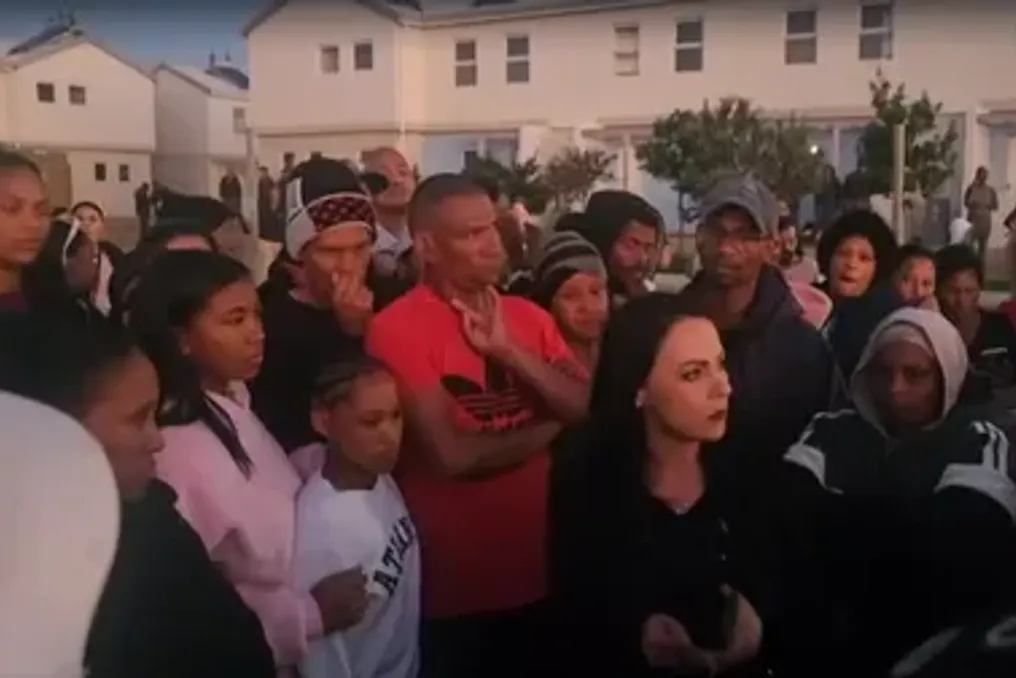
Residents demanding inclusion on the housing recipient list gathered on Tuesday at the Mountain View sites to discuss the situation with the R339 million residential complex.
Residents demanding inclusion on the housing recipient list gathered on Tuesday at the Mountain View sites to discuss the situation with the R339 million residential complex.
Brumilda Amsterdam has been waiting for housing since 2010. She is currently 39 years old and continues to live with her husband in relatives' annex in Mossel Bay, in a space that was never intended for long-term family residence. In 2022, when 242 units were added under the Mountain View project, she reapplied but was told she no longer met the requirements. The reasons were not explained, nor was she provided with information about the First Home Finance programme, how to apply, or her chances.
Aldorin April tells a similar story, but with additional complications. She was first placed on the RDP list, then redirected to a lease-to-own programme, and in 2024, she was informed she no longer qualified for this programme either. She stated that they had lied to her all these years, highlighting the injustice of the situation, as some people received homes while already owning other residences. She noted that her entire family is forced to live in a backyard bungalow belonging to her mother-in-law.
The residents' frustration has a specific location: 242 completed units in 2022 stand empty near their residences. Of the 278 units designated for First Home Finance beneficiaries, only 36 have been transferred and occupied, and another eleven sales are pending completion. The rest remain vacant, while the municipality faces growing pressure from residents and the People's Movement for Change, which threatens mass mobilization due to delays.
Officials point to a new phased sales model designed to expedite subsidy release and bypass rejections from banks that held back many eligible families. This model may assist future applicants. Anco Barker, a representative, stated that the municipality must explain the ongoing vacancy of these units. She emphasized that the poor deserve dignity, not neglect, and demand leaders who serve them, not institutions characterized by arrogance.
Barker also mentioned that law enforcement was mobilized at the entrances to Mountain View, and drones patrolled the area while residents were simply visiting the site. She asserted that if the municipality can mobilize resources to monitor peaceful residents and visitors, it can show the same urgency in providing housing for qualified families.
Municipal representative Sonja Carstens-Johnston reported the deployment of security measures, noting that increased visibility was justified following public statements regarding development. Questions concerning unit occupancy were directed to the Western Cape Infrastructure Department. According to the provincial government, the project includes 725 Breaking New Ground (BNG) units, provided free of charge to approved beneficiaries with a combined household income of up to R3,500 per month. The vacant units are part of the 278 homes allocated to First Home Finance (FHF) programme beneficiaries, formerly known as FLISP. These homes are intended for households earning between R3,501 and R22,000 per month, who do not qualify for free BNG housing but cannot afford standard market housing.
Celeste Nell, the current head of communications for the Infrastructure Department, clarified that 36 out of 278 homes have been transferred and occupied, and another 11 sales transactions are being processed through the FHF programme. Nell stated that the Department, in collaboration with the Mossel Bay Municipality, is actively exploring innovative ways to provide a vital bridge for families whose income is sufficient but who are disqualified by banks due to poor credit history or accessibility issues. She explained that a revised sales plan has been approved to address the high rate of rejections for mortgage bond applications and accessibility problems. This plan allows for the advance release of the FHF subsidy for qualified buyers, lowering the minimum monthly income compared to a standard mortgage bond. It serves as a bridge for families with sufficient income but unable to secure bank financing due to poor credit history or accessibility limitations. Furthermore, the model significantly reduces the initial debt burden for first-time buyers, allowing them to immediately apply the subsidy to reduce the principal debt. This also accelerates the registration process with the Deeds Registry, as it does not require certificates of municipal levy clearance, certificate of contribution clearance, transfer tax or VAT from SARS, nor approval of a mortgage loan from a financial institution.