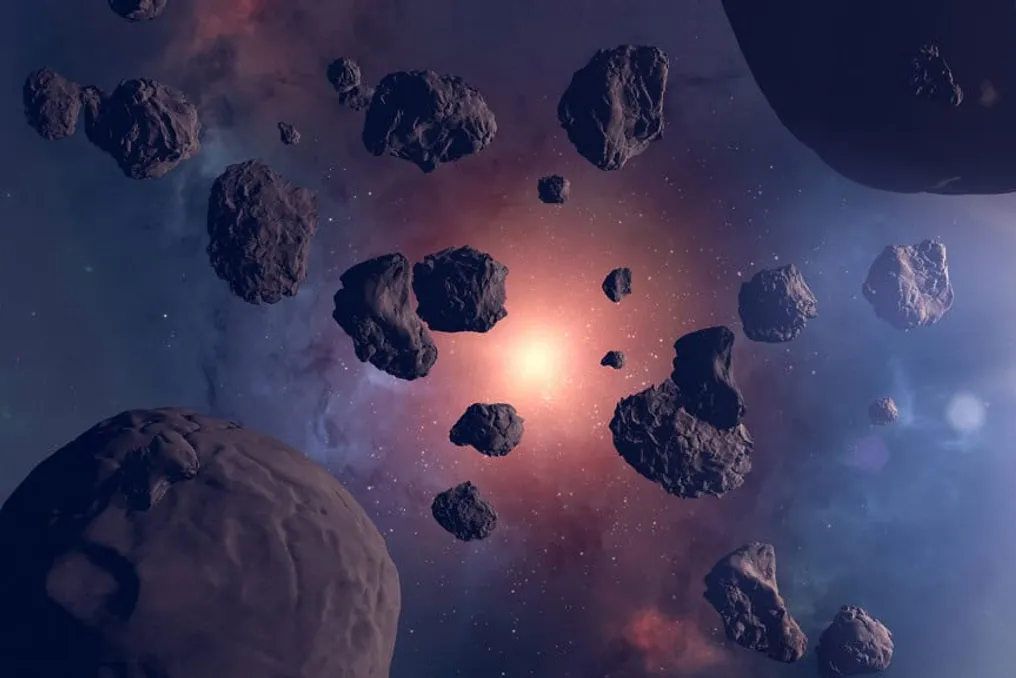
Chinese scientists from the China Academy of Launch Vehicle Technology investigated a tactic to protect the planet against large colliding asteroids, proposing the use of nuclear devices after creating a deep opening in the celestial body.
Analysis of impact methods
This study, published in the journal Space: Science and Technology, compared various ways to detonate charges against space rocks over one hundred meters in diameter, evaluating scenarios with warning times ranging from one to twenty years.
The research concluded that the strategy involving prior excavation followed by deep explosion would be the most effective way to transfer energy to the asteroid, although its practical implementation faces several technical challenges.
Deep impact strategy
The work, coordinated by Xiaowei Wang, focused on solutions for asteroids considered too large to be deflected by traditional means alone. The researchers observed that kinetic impacts or gradual trajectory adjustments might not provide sufficient energy when the reaction time is limited.
The team evaluated two main approaches. The first consisted of hitting the asteroid's surface to form a small cavity and subsequently detonating a nuclear charge in that location. The second option included an extra phase: sending equipment capable of drilling into the object before the explosion, allowing the device to act in a more internal area.
The study's authors determined that the second strategy showed superior performance because internal detonation would allow for a more efficient interaction between the released energy and the asteroid's material. The analysis took into account variables such as launch vehicle capacity, impact velocity, and the modification of the celestial body's trajectory.
Simulation results and limitations
Using a virtual database of threatening asteroids, the simulations tested different preparation periods. The results showed that the deep explosion technique could both destroy objects near one hundred meters and alter the path of asteroids up to about one kilometer, resulting in a modest speed variation over approximately two months.
The surface method, despite being quicker to prepare, was noted as having less control over the impact point, lower energy utilization, and requiring greater equipment resistance and explosion synchronization.
The scientists emphasized that any real mission would need to consider the unique characteristics of each asteroid. For example, the object's composition could drastically change the strategy, as a loose fragment formation would behave differently from a solid rock.
Operational challenges and comparisons
Other points raised included the risk that fragments generated by the intervention could continue to pose a threat to Earth. Additionally, the logistics of transporting and deploying a nuclear device in space constitute an obstacle that must be resolved before any application.
The study compared its suggestions with past planetary defense actions, such as NASA's DART mission in 2022, which managed to alter the orbit of a small asteroid orbiting a larger body. However, the researchers understood that this experiment represented a specific case and not a universal solution for larger threats.
Finally, the authors concluded that the choice of method would fundamentally depend on the warning time. In emergency situations with a large asteroid and little time available, a simpler intervention might be considered; however, with greater advance notice, the option of drilling and deep detonation would be preferable.