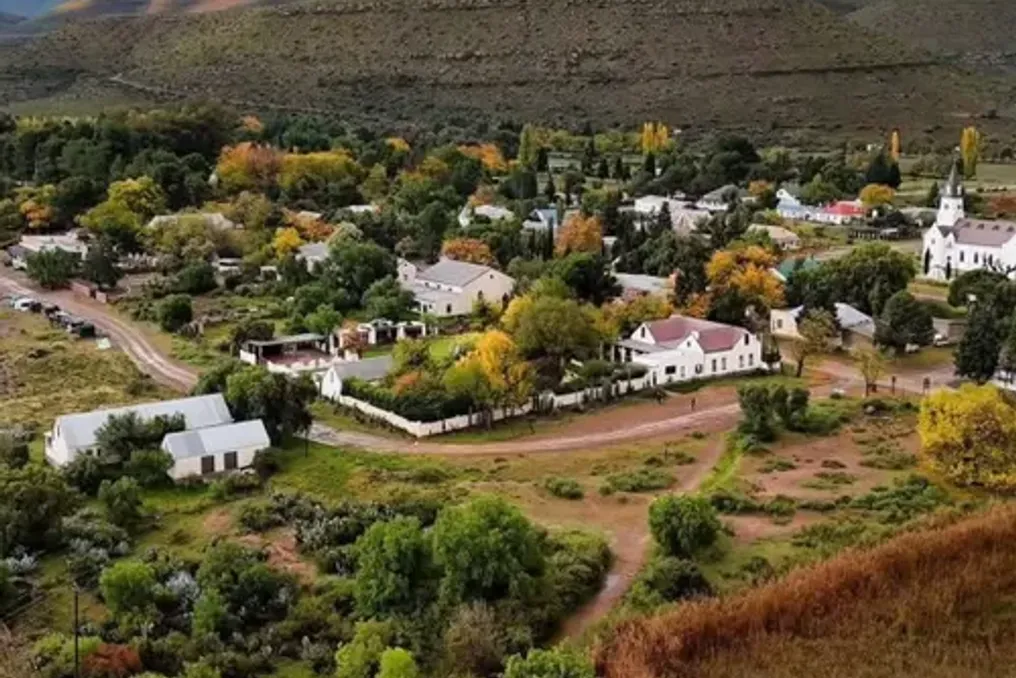
The small village settlement of New Bethesda in Karoo has gained popularity as one of the most interesting places for a short break in South Africa. Its appeal is due to its unique art, prehistoric remains, rich history, and unhurried way of life.
The village itself lacks paved roads, petrol stations, and ATMs. Nevertheless, this tiny settlement has become a desirable destination because of its special rhythm, which combines with the impressive landscapes of Karoo and a developing creative community, setting it apart from other places in South Africa.
New Bethesda was founded in 1875 as a church town, and its name derives from a biblical term meaning 'a place where water flows'. More than one hundred and fifty years later, the village retains this feature thanks to its historical leirwe—a drainage system that channels fresh spring water through gardens and along gravel streets.
The leirwe remains an integral part of daily life and is one of the defining characteristics of the settlement. Walks along these gently flowing channels allow visitors to see a way of life that has barely changed over generations.
No visit to New Bethesda can be complete without seeing the Owl House—a remarkable dwelling created by the late Helen Martins. Seeking a life outside the ordinary, Martins spent decades transforming her modest home into one of the most famous examples of outsider art in South Africa.
She covered the interior walls with crushed glass and, together with local artist Coos Malgas, created hundreds of cement and glass sculptures that adorn the famous Camel Courtyard. Many of these sculptures face east, reflecting Martins' interest in Eastern spirituality. Martins died in 1976 after ingesting caustic potash, but her legacy continues to attract visitors from around the world. The Owl House later inspired Athol Fugard's play 'The Way to Mecca', helping to establish New Bethesda as one of South Africa's most intriguing artistic destinations.
Although the Owl House is the most famous attraction, there are many other places to visit in the village. The Kitchenberg Fossil Study Centre tells the story of Karoo's extraordinary prehistoric past. This region is considered one of the world's richest areas for fossil extraction, and the museum explains how reptile-like mammals lived here about 253 million years ago during the Permian period.
Tours along the beds of nearby rivers allow guests to see fossils still embedded in the rock. Art lovers should visit the Bethesda Art Centre, where colorful textile works, linocuts, and handicrafts celebrate the stories of the Khoisan people, the wildlife of Karoo, and local traditions. A short walk from the village is the Ongeluksluit Rock—an open installation of stone and wire figures that appear to emerge naturally from the surrounding landscape.
If time permits, you can stroll across the suspension bridge over the Gat River, browse books at the Dustcovers bookstore, or simply enjoy the quiet streets lined with beautifully preserved Karoo cottages.
It is necessary to plan your route carefully before traveling. Refuel your vehicle in Graaff-Reinet, Middelburg, or Kadoka, as there are no petrol stations in the village itself. Although many restaurants, guesthouses, and shops accept bank cards, there are no ATMs, so it is useful to carry cash for purchasing local crafts, making small purchases, or tipping.
To fully experience everything New Bethesda has to offer, it is recommended to stay for at least two nights. This will provide enough time to visit museums and galleries, have long lunches, watch the transformation of the Karoo sky at sunset, and enjoy the slow pace that has made this wonderful village one of the most memorable holiday spots in South Africa.