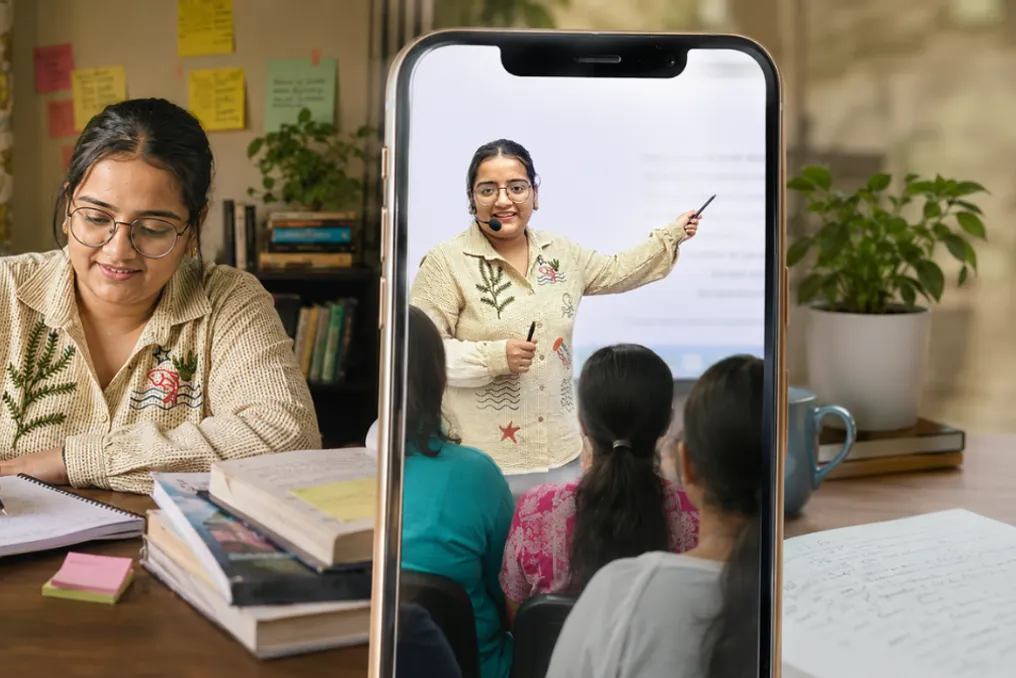
In her home in Baraute, Uttar Pradesh, 27-year-old Richa Jain uses her smartphone to prepare lessons, research topics, and create presentations for thousands of students preparing for the NET and JRF exams. Her initiative, which began as a desire to share knowledge during the pandemic, has evolved into one of the most reliable resources for learning Hindi.
The Path to Education and Overcoming Adversity
For Richa, education has always been a means of gaining confidence and independence. She is currently pursuing a PhD at CCS University and has qualified through the Junior Research Fellowship (JRF) program. However, the path to recognition as an online Hindi instructor was not easy.
Beyond academic goals, Richa struggled with vitiligo, a condition that often drew unwarranted criticism and social judgment. Instead of letting these experiences undermine her confidence, she turned to books. Her family supported her pursuit of learning, which served as a pillar throughout her educational journey, including earning her B.Ed.
The Start of Online Teaching
After successfully passing the NET exam, Richa felt a need to share her knowledge with other students. In 2021, as online education surged due to the pandemic, she decided to start teaching despite lacking a laptop or broadband internet access. She used only her smartphone to create PowerPoint presentations, record lectures, edit, and upload content.
Internet access presented another significant hurdle, as all uploads depended on her family's shared mobile data plans. Creating a single lecture required hours of work, including material research, recording explanations, and final video uploading, which could take seven hours a day while simultaneously preparing for her PhD.
Recognition and Community Growth
Initially, many people were skeptical about the idea of online learning, doubting its effectiveness. Richa faced doubts about whether anyone would seek out such a volume of Hindi educational content. The first months of teaching felt one-sided, as she couldn't see the students' reactions.
However, the situation gradually changed. Comments started appearing under her videos, and students began sharing their results. Approximately two or three years after starting her activities, Richa felt genuine validation of her correctness, realizing that her lessons were truly helping students. Recognition came not only for the accessibility of the content but also for its high quality, especially the detailed approach to past year questions, which helped students understand the origin of answers rather than just memorizing them.
Success Stories Among Students
Among the thousands of students who have benefited from Richa's lessons is 25-year-old Rajni from Bidnjhar. Another example is Devashish from Bihar, living in Delhi, who achieved a perfect score on the JRF exam after using her videos. Student Ananya notes that Richa's courses have become almost synonymous with NET preparation in this subject.
A major advantage for many students is the free nature of the content, allowing them to prepare for NET and JRF even if they cannot afford paid courses. Richa consciously prioritizes this accessibility, believing that education should not be limited by financial circumstances.
More Than a Teacher
Students note that Richa is willing to provide support far beyond classes, advising on academic issues and personal doubts. One of the most touching examples is a 52-year-old man who managed to pass the NET by following her lessons. He told Richa that he wanted to show younger students that it is never too late to achieve success.
Scale and Philosophy of the Platform
Today, her work reaches about 90,000 subscribers on YouTube, and over the years, her platform has helped approximately 50,000–60,000 learners study the material. In January 2025, the Hindi With Richa application was launched, serving over 25,000 active students. Despite the growth, her core idea remains unchanged: quality education must be accessible to everyone willing to learn.
Richa's story also raises the issue of the perception of language education in India, where the dominance of English in academic circles has long prevailed. Her work proves that the quality of education does not depend on the language, making opportunities for growth accessible to countless students.