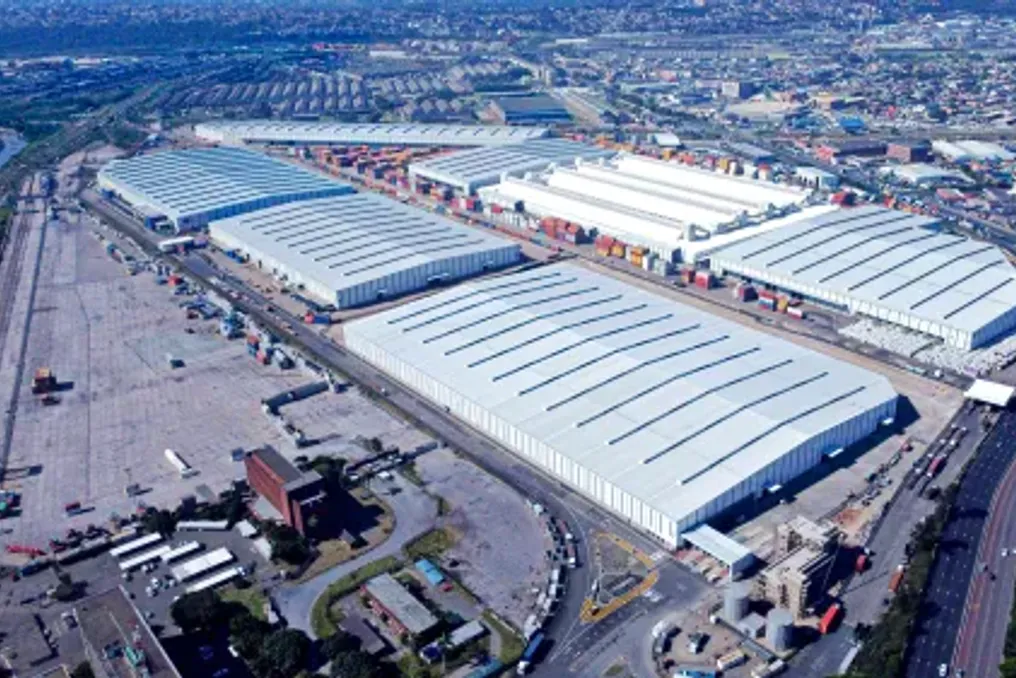
The company specializing in port logistics and infrastructure development in South Africa has concluded a comprehensive financial agreement worth R5 billion. These funds will be allocated to implement the company's national development plan, enabling it to scale its growth.
Funding and Infrastructure Development
The financial solution, developed in collaboration with Absa CIB, will finance the construction of infrastructure assets across key logistics corridors in South Africa. Rajendra Balmahun, founder and CEO of Newlyn Group, stated that Absa CIB designed a bespoke real estate solution under favorable terms, freeing up liquidity for company growth and supporting its financial stability.
Port Logistics and Company Portfolio
Somaya Joshua, Executive Managing Director of Real Estate at Absa Corporate and Investment Banking, noted that this innovative deal demonstrates Newlyn Group's capability to create complex solutions and highlights Absa CIB's strong partnerships with key clients in the real estate sector. Since 1996, Newlyn Group has possessed three decades of experience in the specialized sector of South African port logistics.
The company's national portfolio comprises 32 assets covering over 1.3 million square meters of Gross Leasable Area (GLA), alongside a land bank of 2 million square meters and 200,000 square meters of properties under construction. Newlyn Group intends to develop strategically located, high-efficiency facilities in major coastal and inland logistics hubs across South Africa. The company asserts that its bulk cargo terminal developments aim to enhance efficiency in the bulk logistics sector and transform the country's port logistics landscape.
Rail Transport Prospects
Meanwhile, Old Mutual Alternative Investments views the revitalization of rail transport in South Africa as one of the most significant infrastructure issues in the country. The alternative fund manager noted that the National Rail Plan Project, presented for public consultation in April, outlines a program approaching R2 trillion. This program will utilize both public and private capital over three decades to restore the railway as the backbone of the logistical and transport system by 2050.
According to the fund manager, the signal for investors is clear: this is a structural recovery program in a sector fundamental to exports, industrial production, and national competitiveness. Plan modeling indicates that every Rand invested can increase GDP by approximately R4.3. The fund also points out that the cost of inaction is already reflected in the balance sheet: currently, the railway transports about 165 million tons of cargo annually, while market demand approaches 280 million tons, forcing over 100 million tons onto the road network, thereby increasing logistics costs, congestion, and road safety risks.
Structural Reforms and Capital
For sectors such as mining and agriculture, where the ability to move bulk commodities affordably and reliably directly impacts export revenues, this deficit represents a measurable drag on competitiveness. The company notes that the investment attractiveness stems from the architecture of the proposed solution. Beyond optimizing existing assets and selective expansion, the plan includes separating railway infrastructure from operational activities and opening the network to third-party and private operators. It is these structural reforms that create a genuine channel for long-term capital, transforming the railway from a maintenance problem into a structural opportunity to support the functioning of the real economy.