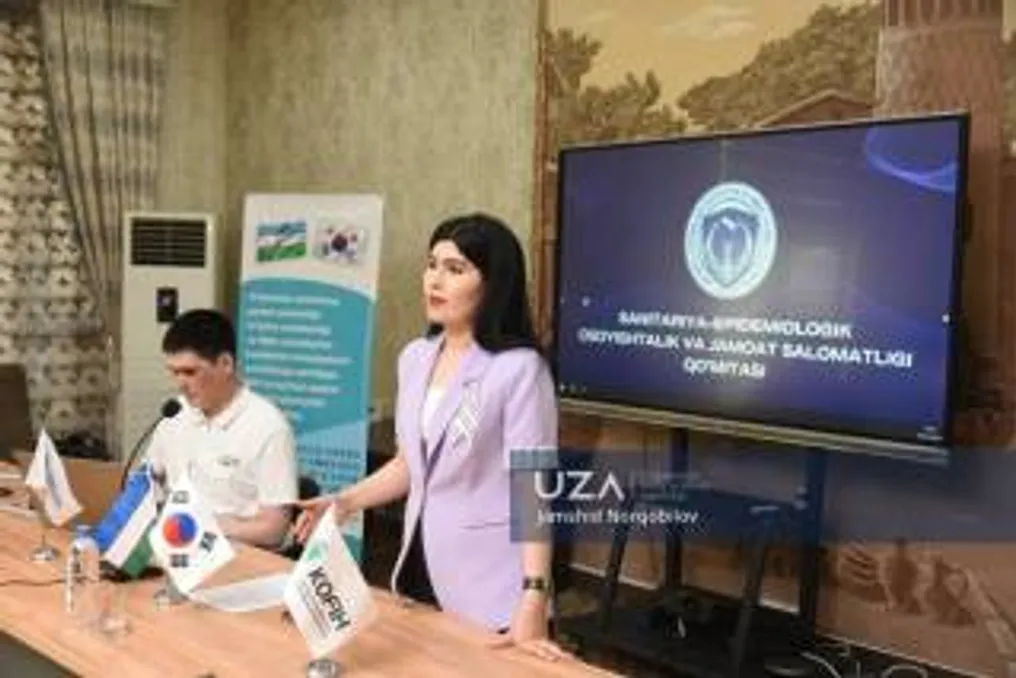
A training seminar on the topic 'The Role of Mass Media Representatives in Improving Public Health Literacy and Strengthening Public Health' was organized in the city of Korshi.
A training seminar on the topic 'The Role of Mass Media Representatives in Improving Public Health Literacy and Strengthening Public Health' was organized in the city of Korshi.
This event took place in cooperation with the Sanitary and Epidemiological Department and the Korean Health Fund. Journalists, press secretaries, and media representatives working in the Kashkadarya region participated in it.
The main goal of the seminar was to strengthen the role of mass media in promoting medical culture and a healthy lifestyle among the population, as well as to improve journalists' knowledge and skills in honest, accurate, and responsible coverage of medical topics.
During the event, specialists provided practical recommendations on conveying medical information to the public in a simple and understandable way, establishing effective communication with the public, and widely covering current healthcare issues. Topics such as preventing the spread of unreliable and false information, working with reliable sources, and the culture of disseminating medical information on digital platforms were also discussed.
Journalist Abdurrazzoq Murodov noted that the seminar allowed him to gain important knowledge about proper and effective interaction with the public and the simple conveyance of medical information. He emphasized that the recommendations on responsible coverage of medical information, relying only on credible sources, and preventing the spread of fake news were very useful for journalists.
The two-day seminar included presentations on topics such as 'Epidemiology of Infectious Diseases,' 'Pandemic Preparedness: Scientific Approaches and Practical Solutions,' and 'The Importance of Prevention in Ensuring Public Health.' Participants had the opportunity to openly communicate with specialists and receive detailed answers to their questions.
It is emphasized that such training sessions play an important role in deepening the understanding of medical topics among media representatives, which, in turn, contributes to providing the population with quality and reliable information. This, in turn, makes a significant contribution to shaping a healthy lifestyle in society, preventing diseases, and strengthening public health.
Large-scale reforms are being implemented in the country's healthcare system to strengthen public health, demonstrating positive results. However, there are also issues that require resolution. This was detailed by expert Muslim Ergashbaev from the Barqaror Rivojlanish Markazi.
In recent years, healthcare has become one of the most important areas of reform in Uzbekistan. The formation of a modern healthcare system that provides quality and sustainable medical services to every citizen is established as a priority task in the 'Uzbekistan – 2030' strategy and the UN Cooperation Program.
These tasks are closely linked to the Sustainable Development Goals objective of 'Ensuring healthy lives and promoting well-being for all ages.' Furthermore, they contribute to the realization of other important tasks, such as poverty reduction, improving education quality, ensuring gender equality, and enhancing the efficiency of state institutions.
Thus, healthcare is viewed not only as part of the social sphere but also as a key factor in the country's sustainable development and human capital growth. Nevertheless, achieving the set goals is not possible solely through adapting infrastructure to modern requirements and implementing new technologies. It requires eliminating systemic problems that have formed over many years and deepening institutional reforms.
It should be noted that thanks to healthcare reforms, the average life expectancy of the population has increased from 67.2 years in 2000 to over 75 years in 2024. The maternal mortality rate has decreased from 42.4 to 26.5 per 100,000 live births. Child mortality has been reduced by more than half over the last twenty years. The coverage rate of children with essential nutrition has reached over 95%. Concurrently, opportunities for using high-tech medical care are expanding, digital technologies are being introduced, and the infrastructure of medical institutions is being updated.
These indicators testify to the firm political will of the state to improve the healthcare system and create a solid foundation for achieving the goals set in the 'Uzbekistan – 2030' strategy.
However, positive changes in several indicators do not mean that all systemic problems in the industry have been solved; most of them persist and require broader institutional transformations. Uzbekistan is among the countries with a middle income and is transitioning into an epidemiological transition stage. In this process, infectious diseases are giving way to cardiovascular diseases, diabetes, oncology, and other chronic ailments, which changes the main risk factors for public health.
A discrepancy arises between the strategic model and current healthcare practice. Despite numerous reforms, the system remains more focused on treating the consequences of diseases rather than preventing them. International experience and scientific research show that investments aimed at prevention, promoting a healthy lifestyle, and early disease diagnosis yield the greatest effectiveness in improving public health.
Considering this factor, the President of Uzbekistan, Shavkat Mirziyoyev, proposed a new model for healthcare functioning, where the main focus shifts from treatment to prevention. According to this model, polyclinics will be evaluated not by the number of services provided, but by their ability to prevent diseases and detect them at early stages. This approach aligns with the recommendations of the World Health Organization and the practices of countries that have succeeded in increasing life expectancy and reducing medical costs.
However, its implementation requires not only organizational changes but also a transformation of the entire healthcare management system, staff training, funding for preventive programs, and the development of public health mechanisms.
Special attention is paid to developing primary health care, as this link is the foundation of a modern healthcare system. Nevertheless, international experience shows that the effectiveness of the primary level is determined not by buildings or equipment, but by human capital—that is, the knowledge and qualifications of medical personnel.
For example, in Estonia and Poland, family medicine reform was carried out parallel to increasing the salaries of general practitioners, expanding their professional autonomy, and introducing a continuous medical education system. Turkey notes the success of its healthcare transformation program due to the creation of a system for incentivizing family doctors based on preventive measures and public health indicators.
Despite significant modernization of the primary care infrastructure in Uzbekistan, issues related to medical staff salaries, career advancement opportunities, and high workload remain relevant. This makes the field of primary health care less attractive compared to specialized or private medical institutions, which hinders the retention of qualified personnel and the attraction of new specialists.
The issue of healthcare digitalization is also highly significant. Electronic medical records, telemedicine, and data management systems are seen as means of increasing efficiency. However, global experience shows that digitalization itself is not a reform. In some countries, expensive digital projects have only complicated bureaucratic processes and increased the burden on medical staff. For Uzbekistan, the main danger is that digitalization may become an end in itself. If the introduction of information systems is not accompanied by the improvement of management processes and decision-making mechanisms, achieving expected results will be difficult. Therefore, the key should not be the number of launched platforms, but the degree of their effective use for shaping health policy.
The influence of environmental factors on public health is also becoming increasingly relevant. Issues related to air pollution, water scarcity, and climate change pose a serious threat to healthcare systems worldwide. For Uzbekistan, this means the need to approach healthcare not as a narrow industry, but as a comprehensive public health system.
Another important problem is the stability of reform financing. Given limited budgetary resources, there is a need to increase spending efficiency. Studies by the World Bank and WHO show that for middle-income countries, the key factor for success is not increasing the volume of funds, but improving the mechanisms for distribution and control of results.
From this perspective, the main task of the Uzbek healthcare system is not to define new goals, as the strategic objectives set by the country align with the international agenda and leading world experience. The main problem is forming the institutional potential for the effective implementation of these goals amid limited resources, staff shortages, demographic pressure, and environmental problems.
Based on this analysis, several priority areas for further reforms can be identified. First, the focus of medical policy must shift from treating diseases to managing risk factors and prevention. Second, a long-term human resource strategy is required, aimed at retaining and improving the qualifications of specialists, especially in the primary health care system. Third, the digitalization process should be viewed not as a technological project, but as a tool for increasing managerial efficiency and decision-making effectiveness.
In conclusion, successfully addressing these challenges will allow the country's healthcare system to transform from a stage of quantitative expansion into a full public health model oriented towards human needs, based on prevention, and compliant with modern international standards. This will not only improve public health but also lay a solid foundation for the country's long-term socio-economic progress.
The Youth Asian Championship for U15 and U19 juniors is taking place in Bangkok, Thailand. The tournament is gaining momentum.
The U15 men's national team of Uzbekistan won against the Kazakhstan team with a score of 3:1 in the round of 16 matches, thus advancing to the quarter-finals of the competition.
The semi-final match held recently as part of the knockout qualifying round featured an intense game between the U15 men's national team of Uzbekistan and leading teams not only from Asia but also from the world—the tennis players of South Korea. In this intense match, our athletes lost to the South Korean team with a score of 0:3, securing 5th place in the continental championship.
As for the U19 national team of Uzbekistan in the junior category, they played a round of 16 match against the Singapore national team. This match ended with a 0:3 victory for the Singaporeans, leading to the elimination of the U19 men's national team from the team competition in the round of 16.
Today, June 30, there will be a match in mixed doubles for the U15 and U19 age groups. The athletes of the Uzbekistan national team will begin their participation in the round of 32 match.
Furthermore, as part of today's championship program, eight tennis players from our country—Lochinbek Abduhalilov, Alikhon Kamolov, Husain Iskandarov, Rahmatillo Abdurashidov, Ezoza Khorozova, Munisa Masharipova, Dilnavoz Omonova, and Adelina Hasanova—will participate in individual matches, testing their luck.
The championship will last until July 5.
An international practical seminar was organized to effectively exchange knowledge and experience, emphasizing the importance of awareness in all areas and applying this knowledge in practice.
The seminar began with a presentation of video material demonstrating the activities and successes of the Turkish Federation of Special Athletes (TOSSFED). Following this, Turkish specialist Dr. Lemon Elmas delivered a lecture on the key principles of working with athletes who have special characteristics in intellectual development, as well as on modern approaches and important concepts in this field.
During the sessions, issues regarding the classification of athletes with unique characteristics in intellectual development were discussed in detail. Participants are provided not only with theoretical knowledge but also with practical skills. Presentations and discussions based on international experience allow specialists to study new methods that can be effectively applied in their work.
In addition to acquiring new knowledge and experience, seminar participants have the opportunity to exchange views with colleagues from different countries who attended the event, thereby strengthening professional ties.