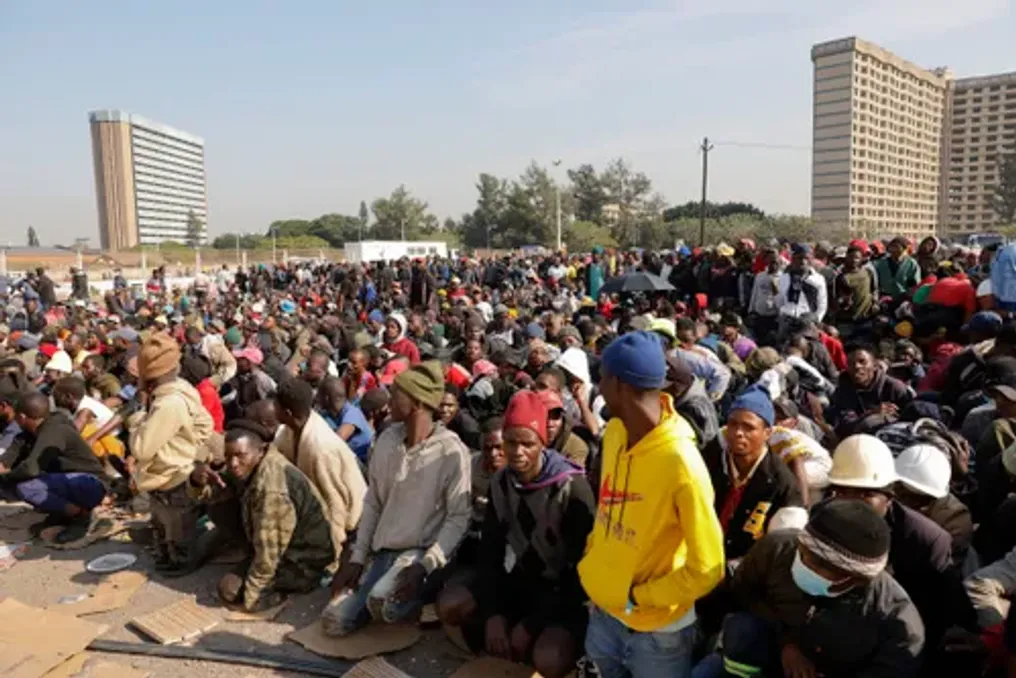
South Africa's legacy of hope is being jeopardized by the resurgence of xenophobia. The author, a rector and vice-chancellor of the North-West University (NWU), expresses deep concern over the threat of large-scale violence and violations directed against undocumented immigrants.
Historical Context and Current Situation
The author recalls a period when South Africa was a focus of global attention, striving to set a moral example after renouncing the repetition of a dark history. He describes moments such as Nelson Mandela's release on February 11, 1990, and the voting on April 27, 1994, when the country opened its doors to all residents. However, after more than 32 years, the author is concerned that citizens are once again threatening violence against foreigners, risking turning the country into an outcast.
Stance on Migration
From the author's perspective, there is no room for illegal immigration because resources are limited, and there is a duty to care for one's own citizens. He argues that South Africans face a choice between tolerating xenophobia or ignoring illegal migration, urging rejection of both extreme approaches. The author emphasizes that when governments fail to manage immigration, ordinary migrants often become scapegoats for state failures, which is an injustice comparable to illegal border crossing.
Role of Higher Education
Citing his university, NWU, the author explains that the word 'universitas' derives from the Latin 'universitas,' meaning 'a community united as a whole.' NWU hosts lecturers, researchers, and students from across the continent because scientific breakthroughs transcend borders, and ideas possess passports more powerful than human documents. A university that isolates itself quickly becomes intellectually poorer, as students develop through interaction with people who think differently.
Balance Between Openness and Order
The author notes that in the public eye, the line blurs between legal migrants, refugees, international students, and skilled professionals, and those who deliberately violate immigration laws, leading to a toxic situation. As public universities, they believe it is their duty to show that openness and order are not mutually exclusive concepts but complement each other. Prosperity is achieved through a combination of openness to people and ideas with accountability, merit, and respect for the rule of law.
Migrant Statistics
Referencing an article in the British publication The Economist, the author presents data that refutes common misconceptions about migration. According to World Bank and OECD studies, foreign residents constitute about 5% of South Africa's population, and migrants are often net job creators, stimulating economic activity. Furthermore, studies have shown that foreign nationals commit crimes less frequently on average than South African citizens.
Conclusion on the Country's Future
The author concludes that South Africa should not choose between openness and order; it needs both. It is necessary to firmly reject xenophobia, strictly adhere to immigration legislation, and continue building universities that welcome ideas from all corners of the world while remaining firmly rooted in the rule of law. He calls for the protection of the legacy of reconciliation and hope so that the world may see that South Africa is not just a point on the map, but an idea worth striving for.