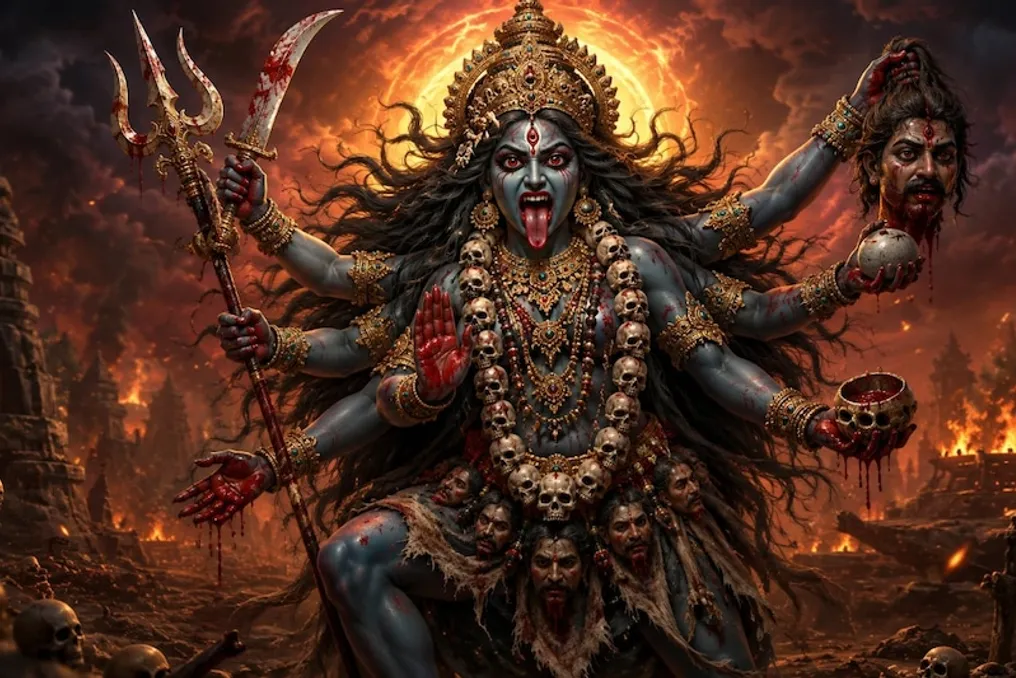
In the atmosphere of night silence and among the dying fires at the cemetery, a terrifying goddess stands, surrounded by ashes. Her unbound hair, necklace of skulls, chalice in hand, and wrath in her eyes make even the gods tremble. This goddess is Mata Chamunda, the goddess of destruction and death. The question arises: who is Maa Chamunda, why did she take an avatar, and why is she worshipped more out of fear than devotion?
The Origin of Maa Chamunda
According to the Markandeya Purana, when lawlessness and terror of demons reigned on Earth, two dreadful asuras named Chanda and Munda seized power, defeating the gods and sowing chaos in all three worlds. Their power was so great that even the gods' weapons proved ineffective against them. Then, at the plea of the gods, Maa Durga appeared on the battlefield. During the battle, her anger intensified to such an extent that a terrible flame burst from her forehead. From this flame arose a fierce goddess with black skin, disheveled hair, a skeletal body, protruding veins, and a fiery gleam in her eyes. This was Maa Chamunda, one of the sixty-four Yoginis.
The Goddess's Mission and Deeds
Maa Chamunda's avatar was summoned solely for the complete annihilation of evil. On the battlefield, she fought with a speed exceeding the wind. In one hand, she held a trishula, in another, a sword, in a third, a chalice, and in the fourth, a vessel filled with blood. In a short time, she killed Chanda and Munda, severing their heads. When she brought the heads of these asuras to Maa Durga, the goddess bestowed upon them a blessing: 'From this day forward, you shall be called Chamunda, and the world will know you as the force of destruction.'
Connection to Tantric Practice
Legend says that Maa Chamunda is also connected to tantric knowledge. She is considered a goddess who resides in cemeteries. In Tantric traditions, the cemetery is a place where the ultimate truth of life and death manifests, where there is no ego or identity, only the connection between the soul and the universe. Maa Chamunda is a symbol of this ultimate truth: everything that is born is destined for an end. This is why symbols such as skulls, ashes, and fire hold special significance in her worship.
It is believed that powerful Siddhas (enlightened beings) perform Sadhana (practice) of Maa Chamunda to rid themselves of negative forces, black magic, and tantric obstacles. Even forces like Brahmrakshasa are considered weak before Maa Chamunda. Today, secret practices of Maa Chamunda are conducted in many Shaktipeethas and Tantric sites in India, especially during Navaratri. Many followers believe that through her grace, impossible things become possible. However, there is a peculiarity in her worship: people remember her more out of fear than love, as her practice is not easy. It is considered possible only with a pure mind, firm intention, and the guidance of a Guru.
Significant Temples of Chamunda
Speaking of major temples, the temple of Chamunda in the Kangra region, Himachal Pradesh, is considered one of the 51 Shaktipeethas. According to legends, the feet of Mother Sati fell here. It is also called Chamunda Nandikeshwar Dham, where Lord Shiva resides along with Maa Chamunda. Furthermore, in Mehrangarh, Jodhpur, Rajasthan, there is an ancient temple of Maa Chamunda. It is said that in 1460, Rao Jodha installed the statue of his Kuladevi here, and since then, Maa Chamunda has been revered as the patroness of Jodhpur.
In Dewas, Madhya Pradesh, there is also her powerful temple at Takeri, where the deity's form changes annually. Although scientists explain this with natural reasons, devotees consider it a miracle. In Chotila, Gujarat, there is also a famous temple of Maa Chamunda, where pilgrims climb hundreds of steps to an altitude of about 1200 feet. Legend has it that it was here that the goddess destroyed Chanda and Munda.