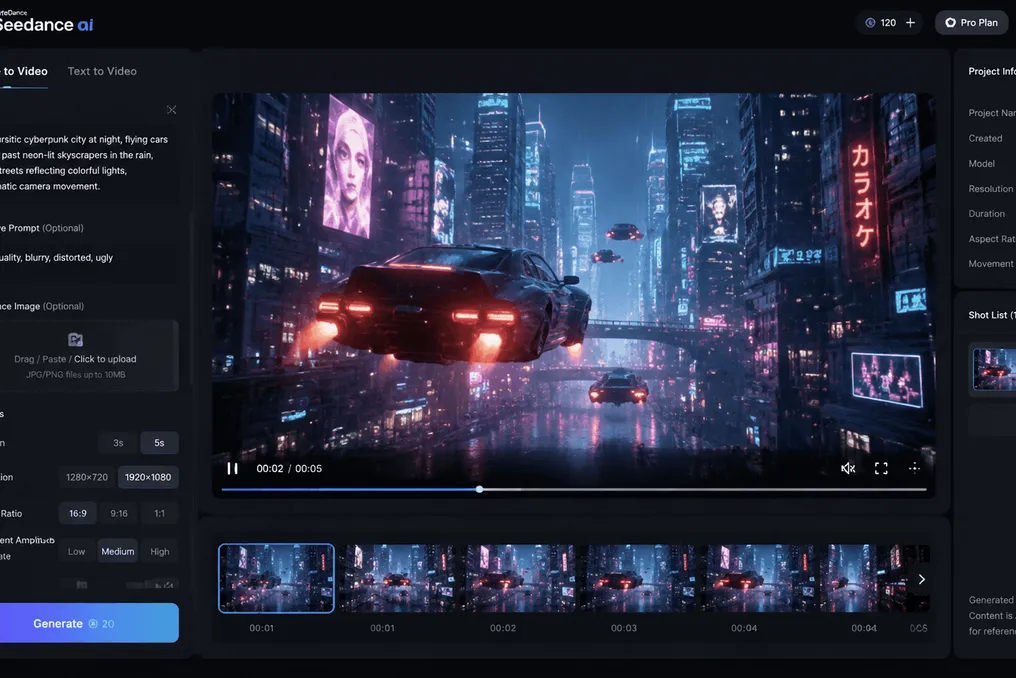
ByteDance's Seedance 2.0 video generation model has become the first in China to demonstrate clear market dominance, achieving a gross profit of 70–90% and redefining the artificial intelligence business model.
ByteDance's Seedance 2.0 video generation model has become the first in China to demonstrate clear market dominance, achieving a gross profit of 70–90% and redefining the artificial intelligence business model.
Seedance 2.0 managed to achieve market supremacy, something other Chinese AI models failed to do, allowing it to set premium prices with a gross profit reportedly reaching 70–90%. According to ByteDance's MaaS Volcengine platform, more than half of the MaaS revenue in 2026 comes exclusively from Seedance.
The model's success story began with researcher Chen Yang, who joined the Seed ByteDance team in 2021. He persistently advocated for training a larger model with at least 200 billion parameters, while internal opinion leaned towards a more cautious approach of 100 billion. Thanks to the support of Seed team leader Wu Yunhui and head of multimodal generation Zhou Chang, this ambitious bet paid off. A source close to the team told 36Kr that 'thanks to Chen Yang insisting that the model needed to be large enough and have rich enough training data, Seedance 2.0 succeeded.'
Seedance 2.0 represents a complete structural overhaul compared to its predecessor. The original PixelDance model used an expanded 2D UNet-to-3D architecture, which proved limited. After the reorganization of ByteDance's AI Lab into the Seed team, the architecture was transitioned to a DiT-based framework, similar to Sora's approach, allowing for better scalability in terms of parameters, data, and computational power. The core team remains small, consisting of just over a dozen algorithm engineers.
The uniqueness of the commercial cycle is as follows: ByteDance's content platforms, such as Red Fruit and Douyin, increased investment in AI-generated content. This prompted production companies to acquire Seedance through Volcengine, which in turn generates greater advertising revenue for the platforms themselves. Thus, a self-sustaining cycle is formed, characteristic of ByteDance's vertically integrated ecosystem.
Compared to competitors like Kuaishou's Kling AI, which at one point controlled nearly 80% of the Chinese video generation market, Seedance 1.0 and 1.5 ranked around fourth globally behind Google Veo. Version 2.0 became a decisive turning point, demonstrating that large models can generate truly profitable revenue rather than just burning through computation costs. The talent acquisition strategy behind Seedance's success reflects ByteDance's aggressive approach to hiring in the AI field: in mid-2024, a special AI recruitment team was formed where HR specialists received annual salaries exceeding one million yuan. ByteDance founder Zhang Yiming returned to direct work, personally meeting with leading AI researchers. The Seed department operates outside ByteDance's standard compensation structure, offering individual packages for priority candidates.