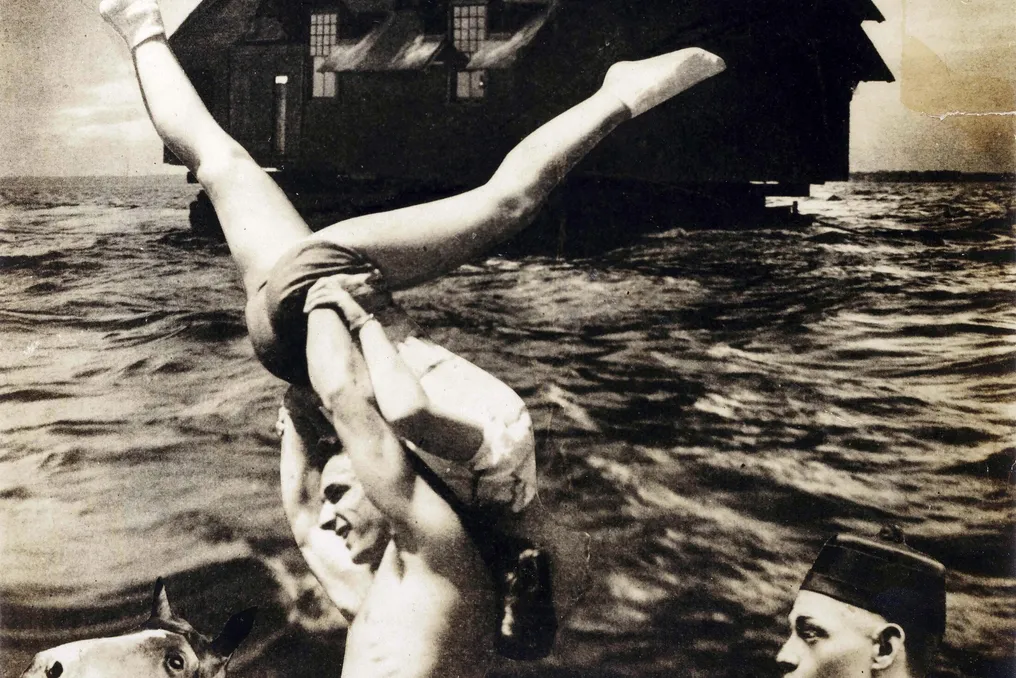
The exhibition, titled 'Surrealisms – Art Beyond Reason,' inaugurates the new headquarters of the Pinakotheke Cultural in São Paulo and proposes a defense of surrealism through a trans-historical and expanded phenomenon.
The exhibition, titled 'Surrealisms – Art Beyond Reason,' inaugurates the new headquarters of the Pinakotheke Cultural in São Paulo and proposes a defense of surrealism through a trans-historical and expanded phenomenon.
The exhibition establishes a connection between contemporary and modernist works. Examples include 'Homage to Meret Oppenheim' (2024-2026), from Lenora de Barros's series of ping-poems, and 'Tarsila with Orange' (2011), by Erika Verzutti. These pieces dialogue with modernist artists. Although Meret Oppenheim (Berlin, 1913 – Sion, 1985) was associated with surrealism in her time, Verzutti, Lenora, and Tarsila do Amaral (Capivari, 1886 – São Paulo, 1973) are part of the concept of Surrealisms – Art Beyond Reason.
The curation, led by Tadeu Chiarelli and Max Perlingeiro, director of the Pinakotheke, uses Leonora Carrington's phrase, 'surrealism is a state of mind and nothing more,' as an epigraph. The show brings together about one hundred works by sixty artists from European, Latin American, North American, and Caribbean backgrounds, united by a focus on subjective, dreamlike, psychological, fantastic, erotic, and magical dimensions.
A central point of the exhibition lies in the interactions between the works, observing how they silently correlate, referencing the practices of the first surrealist nucleus, such as automatic writing and games of bringing disparate elements together, known as cadavre exquis. For example, the video performance 'Uterine Veil' (2020), by Lia Chaia, where the artist's body is covered by an image of a uterus made of voile fabric, finds a parallel in 'The Hidden Kiss' (1976), by Leonor Fini, which depicts two figures sheltered under a red fabric. Furthermore, the jug that continuously pours water, present in the video 'Half Full, Half Empty' (2009), by Katia Maciel, functions as a living element in the phantasmagoric wall that unites photomontages by Athos Bulcão, Jorge de Lima, Grete Stern, Antonio Berni, and Guignard.
Like other historical avant-gardes, surrealism was predominantly composed of male and European artists and poets, with centers of activity in Paris, London, and Prague. However, Latin American artists such as Roberto Matta (Chilean), Wifredo Lam (Cuban), Maria Martins (Brazilian), who participated in the International Surrealist Exhibition in New York in 1947, and Sergio Lima, who received the mission from André Breton to organize an International Exhibition in São Paulo in 1968, are considered those who truly adhered to the movement. In the exhibition, Lima's collage-object 'The Magnifying Glass' (1976) is complemented by works by Tunga, Claudio Cretti, and the cinematic masterpiece of surrealism, 'Un Chien Andalou' (1929), by Luis Buñuel and Salvador Dalí. A more private encounter occurs between various sculptures and engravings by Maria Martins and an enigmatic and erotic object by Marcel Duchamp.
According to researcher Dawn Adès, cited in the exhibition book, historical surrealism functioned as a collective that valued coexistence, interaction, and community activity in everyday encounters in cafes. Thus, the show 'Surrealisms – Art Beyond Reason' evokes rumors of a truly anti-conformist party, as paraphrased from a text by Juliana Monachesi for the book 'Sergio Lima – Image Event.'