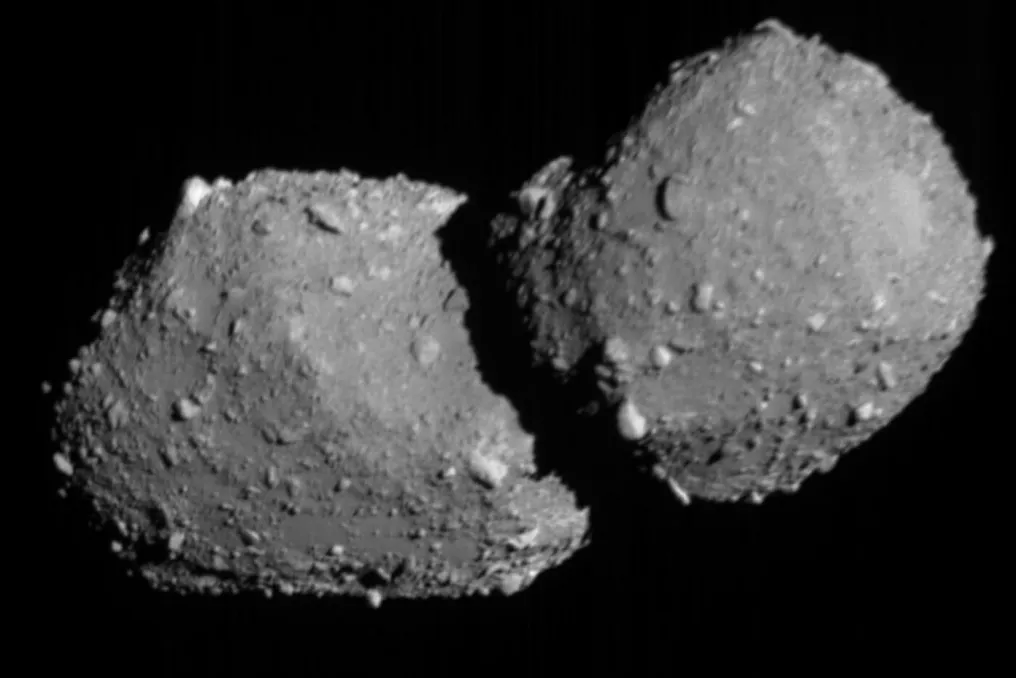
The Japan Aerospace Exploration Agency (JAXA) published new images on Monday (the 6th) obtained by the Hayabusa2 probe during its flyby of the near-Earth asteroid Torifune. According to scientists, this celestial object has a shape resembling a 'snowman'.
Mission Objective and New Data
The Hayabusa2 spacecraft, comparable in size to a refrigerator, passed by the asteroid on Sunday (the 5th) as part of a mission aimed at demonstrating the ability to deflect potentially hazardous rocky bodies from Earth's trajectory. The new image presented by JAXA may contribute to future planetary defense strategies, as researchers note the wide variety of sizes, shapes, and surface characteristics of near-Earth asteroids.
Scientists' Comments
JAXA scientist Yuya Mimasu shared his impressions, telling journalists: 'The moment I truly saw this image and the scientific data... it really moved me.' He noted that the asteroid 'personally looked like a snowman.' The black-and-white image, taken by the probe's telescopic camera, shows two rounded objects connected to each other. Mimasu added: 'You can really see the rocks... I absolutely did not expect to take such a photograph, so I am over the moon.'
Testing Defense Technologies
This mission follows a successful test conducted by NASA in 2022, where a spacecraft intentionally altered the orbit of the asteroid Dimorphos through impact. Although it was previously known that Torifune has an elongated shape, details of its structure remained unknown. Hayabusa2 traveled at a speed of over 18,000 km/h and was supposed to pass at a distance of about 800 meters from the asteroid. However, JAXA reported that it will further analyze the exact distance achieved during the flyby. If this value is confirmed, the mission could become one of the closest flybys of a near-Earth asteroid. The agency also reported that it managed to obtain data from three other scientific instruments capable of measuring the distance to the asteroid and investigating the presence of water.
Future Tasks of the Probe
JAXA and the European Space Agency (ESA) are jointly working on another planetary defense mission aimed at studying the asteroid Apophis, which will pass close to Earth in April 2029. Hayabusa2, launched in 2014, already attracted attention by landing on the asteroid Ryugu, located approximately 300 million kilometers from Earth, and collecting samples of its surface. Six years later, the probe returned to Earth with this material, allowing scientists to gain insights into the conditions of the Solar System during its early stages of formation, about 4.6 billion years ago. After the Torifune mission, in 2031, Hayabusa2 is scheduled to encounter asteroid 1998KY26. At this stage, the spacecraft will either fly past the celestial body or land on it to collect detailed scientific data.