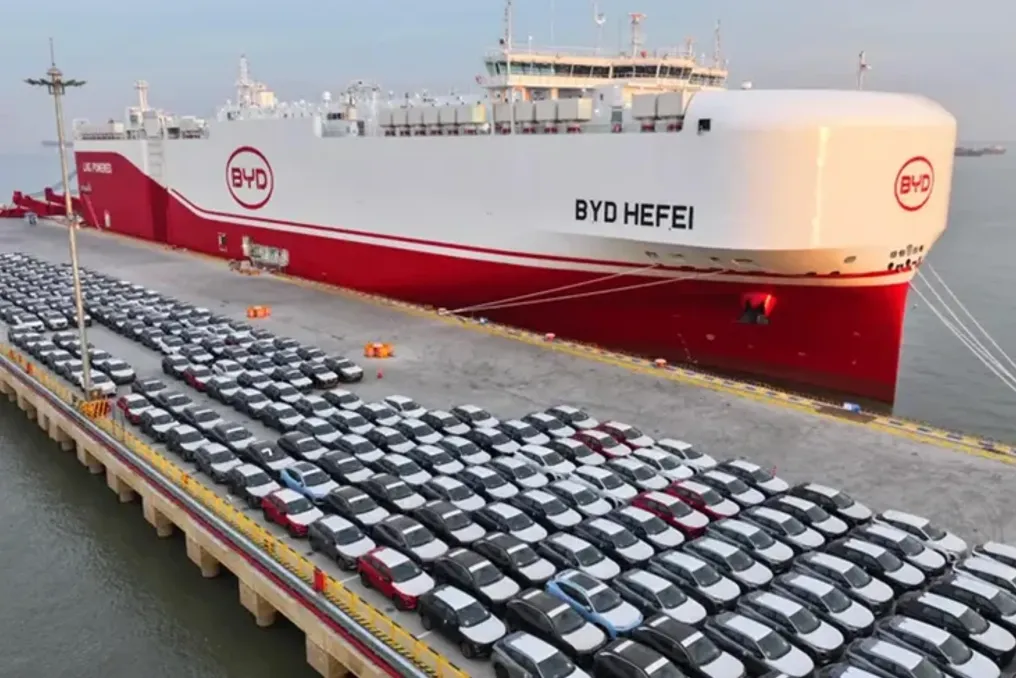
The slowdown observed in the electrified vehicle market in China is forcing local manufacturers to intensify their international export strategies. Despite being the world's largest electric car market, China is facing declining sales, driven by both the reduction of government subsidies and lower domestic demand.
Export Projections and Domestic Performance
Chinese companies are projected to ship approximately 10 million vehicles in 2026, representing a significant increase of 41% compared to the 7.1 million shipped in 2025, according to the consultancy AlixPartners. Foreign sales have become the main driver of growth in the face of domestic consumption stagnation, helping the country maintain its global leadership in exports, surpassing Japan in the previous year. Chery leads this movement, having shipped 1.34 million units in 2025.
Domestically, indicators show a downward trend. According to data from the Chinese Passenger Car Association, in June, 1.04 million battery electric and plug-in hybrid vehicles were registered, which constitutes a 7% reduction compared to the same period in 2025. In the first half of the year, sales totaled 4.73 million units, marking a contraction of 13% over the annual base.
Economic and Regulatory Factors
Several elements contribute to this scenario. The Chinese economy is still in a phase of slow recovery, leading some consumers to postpone purchases in expectation of further price cuts. Additionally, state support for so-called New Energy Vehicles (NEVs) has been progressively decreasing. This year, Beijing began the gradual withdrawal of the sales tax exemption granted to manufacturers. Furthermore, it was confirmed that annual tax benefits for battery electric vehicles, plug-in hybrids, extended-range models, and fuel cell-powered commercial vehicles will be reduced starting January 1, 2027. However, the applied discount is modest, currently ranging between 360 and 660 yuan (equivalent to US$ 53 to US$ 97) per year.
Market Challenges and External Risks
With profit margins becoming increasingly tight, profitability remains concentrated in a few companies. Currently, only three Chinese automakers can operate profitably in the electric sector. AlixPartners predicts that at most four more companies will reach the break-even point by 2030, while smaller manufacturers risk being absorbed by larger competitors or abandoning the market. However, the focus on foreign markets is not without dangers. The imposition of higher tariffs in Europe and North America increases the cost of Chinese automobiles, compresses operating margins, and complicates long-term planning, precisely when brands are most dependent on sales outside the country.