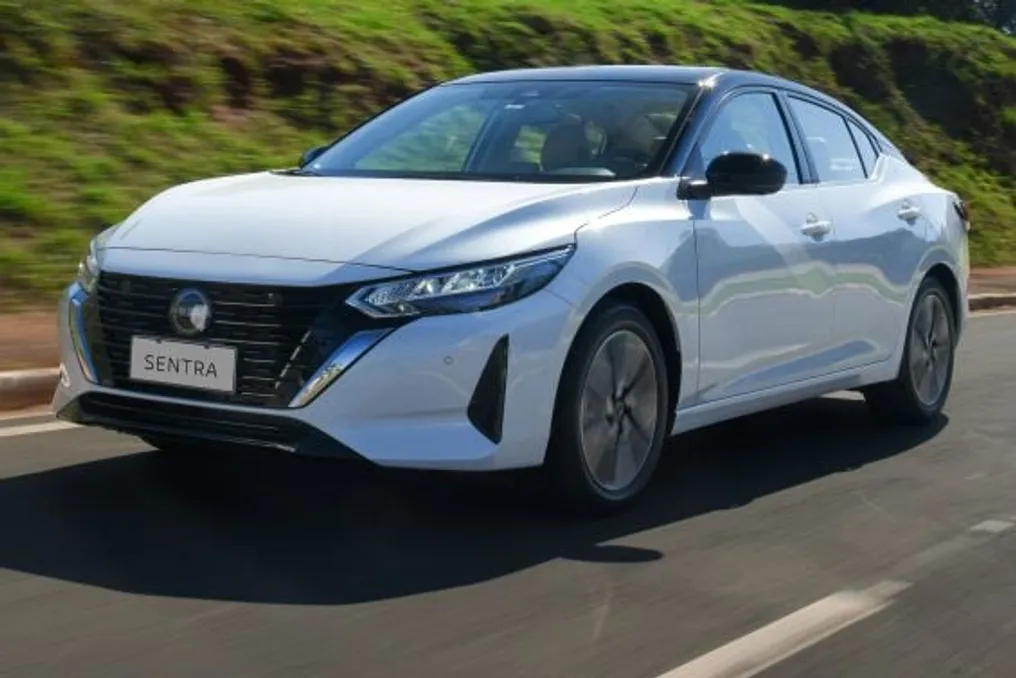
Nissan has announced the discontinuation of the Sentra sedan in Brazil. After about three years of sales, the Mexican imported version will be removed from the Japanese automaker's portfolio, as reported by Autoesporte magazine.
Sentra Performance and Discontinuation
The manufacturer's decision was officially classified as part of the product's 'natural life cycle,' without detailing immediate plans for a direct successor. The Sentra's sales performance was not satisfactory; between January and June of this year, the model registered only 341 registrations, with only nine units sold in June.
This low volume contrasts sharply with the Toyota Corolla, which led the category, achieving 13,021 sales in the same period. Despite having an updated design and features that could attract customers, the Sentra failed to overcome the disinterest of the Brazilian public.
Sales Attempts and Model Features
The dealership network attempted to reverse this trend using aggressive bonuses, reaching up to R$ 30 thousand, but even the price reduction could not boost sales. The mid-sized sedan is losing relevance against the growth of SUVs and the arrival of new hybrid and electric competitors, which offer greater resale value.
Technically, the Sentra came equipped with a 2.0 naturally aspirated engine, generating 151 hp and 20 kgfm, coupled with a CVT transmission and front-wheel drive. Its dimensions were 4.64 m in length, 1.82 m in width, and 2.71 m in wheelbase, with a trunk capacity of 466 liters, which was 37 liters smaller than the previous generation. In Brazil, the 2026 line was offered in Advance and Exclusive versions, with suggested prices ranging between R$ 174,490 and R$ 198,790.
Future Strategy and Possible Chinese Replacement
The withdrawal of the Sentra is part of Nissan's strategy to focus on higher-circulation models, such as the Kicks and Kait SUVs, keeping only the Versa 1.6 among entry-level sedans. There are speculations that the company is analyzing the introduction of an electrified vehicle of Chinese origin.
The most discussed model is the N7, an electric sedan developed by the Dongfeng Nissan joint venture and which has already been seen in tests in the country. This car is larger than the Sentra, featuring a length of 4.93 m. For now, Nissan has stated that it will communicate its new product strategy at an 'appropriate time.'
Technical Details of the Nissan N7
The N7 is a fully electric sedan produced in Guangzhou, China, by the Dongfeng-Nissan joint venture, and arrived at dealerships in April 2025. It has larger dimensions than the Sentra: 4.93 m in length, 1.90 m in width, and 2.92 m in wheelbase. Its technical specifications include two battery options—58 kWh and 73 kWh—combined with motors producing 218 hp or 272 hp. The range, calculated by the Chinese CLTC cycle, varies between 510 km and 635 km, according to Nissan.
In the Chinese market, the N7 costs between 119,900 and 149,900 yuan, which is equivalent to approximately R$ 91 thousand to R$ 114 thousand in direct conversion, without considering import taxes. The presence of a unit of the sedan circulating on Brazilian streets corroborates the hypothesis that it will be considered a replacement for the Sentra. Nissan has already informed that it will begin exporting electric vehicles manufactured in China to other markets starting in 2026, although it has not specifically mentioned Brazil among the initial destinations.
A price estimate for the N7 in Brazil, based on comparative calculations, suggests a range between R$ 180 thousand and R$ 225 thousand, should Nissan decide to import it without local production, applying an 'import multiplier' that includes freight, taxes, resale margin, and homologation costs.