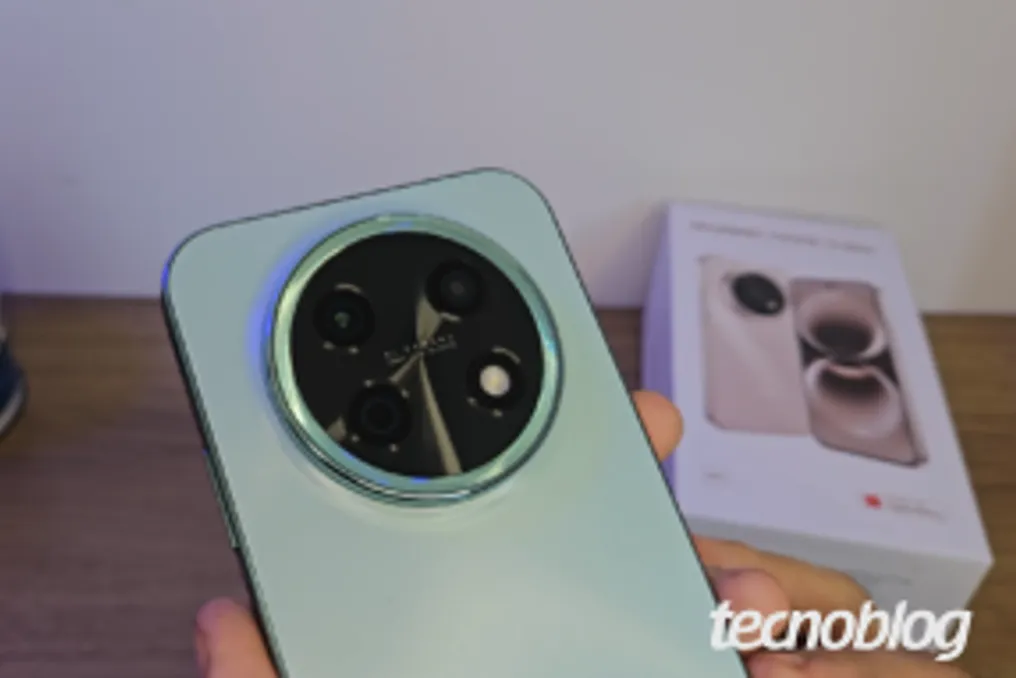
The Huawei Nova 15 Max stands out for having a robust 8,500 mAh battery and an OLED screen with a brightness capacity of up to 4,000 nits. This device represents the brand's strategy in the mid-range segment, launched in Brazil with an initial price of R$ 1,999, although its official value is R$ 2,999.
Overall Device Evaluation
Although it offers superior autonomy compared to the average, the phone presents notable restrictions, such as an outdated operating system and the lack of Google services. After fifteen days of testing, the author details whether the positive aspects compensate for the software difficulties and the considered mediocre performance.
Design and Screen
The design surprisingly impressed positively, remaining slim despite the voluminous battery. It features a screen with rounded and thin edges, and the glossy plastic body gives it a premium look. With dimensions of 163.3 mm in height, 78 mm in width, and 8 mm in thickness, and weighing 253 grams with the case, the device has IP65 protection against dust and water jets.
The 6.84-inch screen uses an OLED panel, providing vibrant colors and good sharpness with Full HD+ resolution. A strong point is the maximum brightness of 4,000 nits, which ensures usability under intense sunlight. The 120 Hz refresh rate significantly contributes to fluidity in browsing and media playback. Huawei included a protective film on the screen.
Audio and Camera Features
The sound system is powerful but causes discomfort at maximum volume due to noise and a metallic aspect in music reproduction. There is a perception of imbalance, with insufficient bass and shrill treble.
In terms of photography, the Nova 15 Max focuses on a 50 MP main camera, complemented by a secondary 2 MP depth sensor and an 8 MP front camera. Although post-processing utilizes artificial intelligence features, the results in the gallery are satisfactory. The main camera records with good sharpness and effective HDR, but optical zoom is non-existent, limiting quality at 5x or 10x magnification.
Portrait Mode works well during the day but loses quality and sharpness at night, aggravated by the lack of stabilization. Selfies are considered inferior to rear photos, showing limitations in image processing. In videos, the model achieves 4K at 30 fps on both the rear and front, but the absence of OIS harms the consistency of recordings.
Performance and Capabilities
For daily tasks, such as social media, streaming, and web browsing, the performance is effective. The device features an 8-core HiSilicon Kirin 8000 processor, 8 GB of RAM, and 256 GB of storage. Although this capacity may be limited for those who record a lot in 4K, the set supports editing in CapCut and the use of AI apps like Gemini.
Game tests showed that Call of Duty experienced slight stuttering at maximum settings, and Genshin Impact required medium/minimum settings to maintain an acceptable frame rate. The device tends to heat up during prolonged gaming sessions. In benchmarks, it achieved 858 points in single-core and 1,874 in multi-core, falling behind mid-range competitors.
Software Limitations and Connectivity
A major obstacle is the operating system's limitations. When turning on the device, the user is encouraged to install various Chinese applications and casino platforms. Furthermore, the native absence of the Google services package prevents the use of common Brazilian apps, such as banks, from the official store.
The alternative is the GBox app on the AppGallery, which simulates the Google store, allowing the use of apps like Bradesco and Nubank, except for contactless payments. NFC exists but is not enabled for use in Brazil, and Android Auto does not work, limiting Bluetooth use only to calls.
Regarding biometrics, facial recognition operates perfectly, while fingerprint scanning is more sensitive to conditions such as sweaty hands. AI tools, such as the 'Best Expression' feature, worked well, altering faces in photos naturally.
The Nova 15 Max runs EMUI 14 based on Android 12, released in 2021, and there is no clear information about future software updates.
Battery Advantage
The 8,500 mAh silicon-carbon battery is the main attraction. In tests, the device lasted two days with moderate use, starting at 100% at 7 PM and requiring recharging only after 48 hours. A full charge with the 40W charger took 1 hour and 32 minutes. It is important to note that the 40W charger is not included in the box.
Additionally, the phone functions as a power bank thanks to reverse charging via USB-C cable.