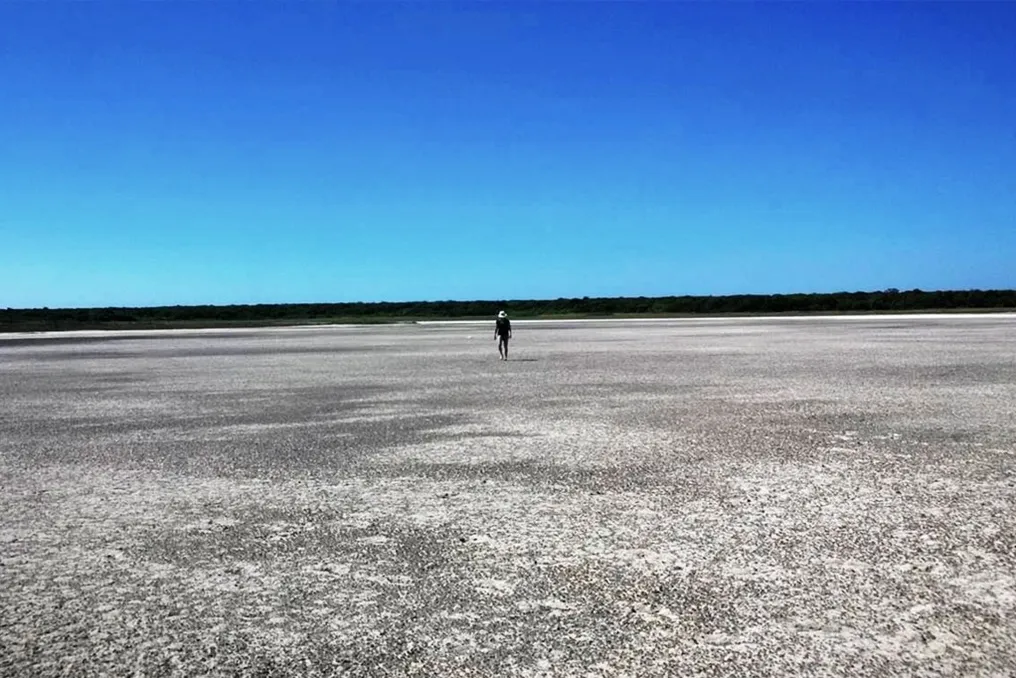
Researchers are analyzing whether the hypersaline lagoon located on the coast of Rio de Janeiro possesses characteristics similar to the intermittent lagoons found on the surface of Mars. To help answer one of the most fascinating questions in space exploration—whether Mars can harbor life as we know it—scientists from the Astrobiology Laboratory (AstroLab), affiliated with the Institute of Chemistry at the University of São Paulo (USP), are using the bacterium Staphylococcus nepalensis (S. nepalensis).
The bacterium and its extreme habitat
S. nepalensis, initially discovered in 2003 in the digestive system of goats in Nepal, was later detected in various other hosts and environments, including the saliva of domestic cats and certain hypersaline lagoons in the Araruama area, Rio de Janeiro, where salt concentration exceeds that of seawater.
Due to its remarkable ability to survive in such a severe environment, this bacterium is being studied in experiments that replicate extreme Martian conditions, such as those found in so-called intermittent brines—small flows of highly salty water that briefly appear on the surface of Mars.
Study of resistance to adverse conditions
Analyzing how the bacterium resists high levels of salt and abrupt changes in salinity allows understanding the potential for transient Martian environments, like these brines, to meet the minimum requirements for the survival of extremophile microorganisms, living beings adapted to extreme conditions for most known forms of life.
In 2019, a research group linked to AstroLab located S. nepalensis in samples collected from the lagoon complex spanning six municipalities in the Lagos Region, on the coast of Rio de Janeiro state (RJ), which holds the largest mass of permanent hypersaline water on the planet. The bacterium was specifically found in Brejo do Espinho lagoon, a saltwater body connected to the sea by a channel, characterized by low average depth, varying between 2 cm and 2 m, which intensifies salinity variation throughout the year.
During dry periods, salt concentration increases significantly, while during rainy seasons, it drops drastically. S. nepalensis has demonstrated such effective adaptation to this seasonal oscillation that it has become a valuable model for testing how microbial life could persist in an extremely hostile place like the Martian surface.
Salt chemistry on Mars
Sodium chloride is the most common salt on our planet, as is calcium carbonate, calcium sulfate, and sodium bicarbonate. None of these salts exhibit caotropism, the property of disorganizing vital macromolecules such as proteins and DNA, which would lead to the destruction of chemical bonds and loss of biological function.
In contrast, the saline composition of Mars is distinct. Since 2008, through the Phoenix mission, it is known that the Martian surface contains considerable amounts of perchlorates, salts uncommon on Earth. Calcium, magnesium, and sodium perchlorates present on Mars are highly caotropic. However, one characteristic of these salts offers optimism: perchlorates, especially those of magnesium and calcium, are hygroscopic, attracting water molecules and drastically lowering the freezing point of aqueous solutions.
This could favor the formation of brines on the Martian surface, where the average temperature is approximately -60 °C, potentially varying between -150 °C at the poles and +20 °C near the Martian equator. Even in small and intermittent quantities, this hypersaline liquid water could exist during the planet's summer, an encouraging piece of data for the possibility of some form of life sustaining itself there. Additionally, extremophiles found in the Atacama Desert, Chile, use perchlorates as an energy source, and this desert is considered an analog environment to Mars.
Summer cycles on the Red Planet
The AstroLab research group investigates how S. nepalensis can adjust to Martian conditions, utilizing its mechanisms to cope with the effects of perchlorates. The focus is on understanding the microorganism's response to the cycles of intermittent Martian summer brines, which freeze at night and return to a liquid state during the day.
Martian brines are not stable. With the increase in daytime temperature, the water melts, becoming more accessible for biological chemical reactions. Simultaneously, the greater presence of liquid water dilutes the salt accumulated in the brine. As night falls and the surface temperature decreases, the opposite occurs: the solutions freeze, reducing available liquid water and promoting desiccation and increased salt concentration in the ice.
This instability imposes significant biological challenges to known life over short periods. The results of the experiments, informally dubbed 'Summer on Mars,' may indicate whether the adaptive flexibility of S. nepalensis, observed in the Rio de Janeiro lagoon, can serve as a pathway for adapting to Martian environmental stressors.
Genetic mechanisms and adaptation
Besides tolerance to large salinity variations, S. nepalensis is also studied for its ability to perform horizontal gene transfer of antibiotic resistance genes to Staphylococcus aureus (S. aureus), a species of the same genus found on the skin and respiratory tracts of humans and other animals.
Unlike S. nepalensis, S. aureus can cause serious infections and has been the subject of research due to its lethality in certain cases. Horizontal gene transfer is particularly concerning because it can increase S. aureus's resistance to existing treatments. This mechanism occurs within the same generation, allowing the acquisition of new traits without depending on genetic inheritance across multiple generations, accelerating adaptation to selective environmental pressures.
AstroLab researchers also examine the genetics of S. nepalensis to discover the molecular mechanisms behind this adaptive capacity, aiming to identify which genes are activated when the bacterium is exposed to stressors such as high concentrations of perchlorates and extreme salinity variations. The findings of these studies should deepen the knowledge about Mars' habitability and the possible modes of microbial life adaptation to extreme conditions on other celestial bodies.