A small satellite launched by SpaceX may represent a significant step in space exploration. The BOHR satellite, developed by City Labs, was sent into space to test a microenergy source based on tritium.
A small satellite launched by SpaceX may represent a significant step in space exploration. The BOHR satellite, developed by City Labs, was sent into space to test a microenergy source based on tritium.
According to the publication Science, the mission aims to evaluate a technology capable of providing continuous power supply to space equipment, especially in conditions where relying solely on sunlight is difficult.
BOHR (Betavoltaic Orbital High-Reliability) was launched into space on July 7 aboard a Falcon 9 rocket as part of the joint Transporter-17 mission. The launch took place at the Vandenberg Space Force Base in California. The rocket carried 81 payloads and began deploying equipment into orbit approximately 50 minutes after liftoff. Among the deployed devices was a CubeSat from City Labs, a company based in Florida.
This mission demonstrates NanoTritium technology—a betavoltaic microenergy source that converts beta particles released during the radioactive decay of tritium into electricity using a semiconductor. This marks a historic moment for commercial nuclear energy in space, noted Peter Kabaui, CEO of City Labs.
Despite the progress made, BOHR currently uses solar energy for its general operations. The purpose of the test is to assess an alternative that will eventually help space equipment function in areas with low solar panel efficiency.
Expected applications for this technology include long-duration space missions, equipment in areas with insufficient sunlight, research in permanently shadowed regions of the Moon, as well as new commercial and defense needs in space. The lunar south pole is of particular interest for such a solution, as it is a target for NASA's Artemis missions due to the presence of water ice, which is vital for future human activity on the Moon.
City Labs asserts that tritium-based systems have a low level of radiation and can be prepared for transport, handling, and integration into commercial launches. Kabaui stated that 'BOHR demonstrates that safe, compact, regulatory-approved nuclear energy systems are ready for routine commercial deployment.'
The project received funding through a contract with the United States Department of Defense, and according to the company, this was the first mission to use nuclear energy authorized by Federal Aviation Administration (FAA) regulations for such launches. The results of this test will help determine the next steps in developing compact energy technologies for private and governmental space missions.
Ten years ago, the Yusonna automatic interplanetary station began its operation in Jupiter's orbit, constantly providing planetologists with new data about the Solar System's largest gas giant. The collected information helps scientists understand the mechanisms of the origin and development of this gas giant, and also provides keys to understanding processes occurring on exoplanets.
In mid-2021, an expanded scientific program for Yusonna was launched. The spacecraft continues to be the only research station operating between the orbits of Jupiter and Pluto. While the station's initial focus was on the gas giant itself, its tasks now include close flybys of large moons: Ganymede, Europa, and Io.
Ganymede and Europa received three flybys each, while Io, being the most volcanically active body in the Solar System, was surveyed sixteen times. Thanks to these observations, planetologists were able to discover fresh lava flows and active lava lakes. A three-dimensional model of one of Io's mountain peaks with its characteristic shadow against the backdrop of colorful volcanic landscapes was created, and high eruption 'umbrellas' were recorded.
During a close flyby on October 16, 2023, the most detailed image of Io's day and night sides was obtained. It shows Mount Dith—an elongated peak 5–7 kilometers high, casting a distinct shadow. This mountain is named after a city from Dante's work. Additionally, in May and December 2023, Yusonna's instruments recorded a 65-kilometer active lava channel in Paterae Gal, which was compared with another channel on Io.
Yusonna's JIRAM instrument made an infrared image of active volcanoes in Io's southern hemisphere on December 27, 2024, where a record-active hot spot was observed to the right of the south pole. Io has over four hundred volcanoes. Initial data on their properties and locations suggested the presence of a global subsurface magma ocean, but scientists concluded that the situation is more complex: the moon likely has both deep magma reservoirs and shallowly buried melts.
During a flyby on October 15, 2023, Yusonna photographed the plume of the Prometheus volcano near the day-night boundary. Rings of volcanic ejecta around Paterae Nucum—sulfur-rich deposits about 1100 kilometers wide, formed during a two-month observation break—were also recorded.
On Ganymede, Yusonna discovered organic molecules and recorded auroras similar to those on Earth and Jupiter. As for Europa, known for its subsurface water ocean, the station refined the average thickness of the ice crust, which reaches 29 kilometers. Yusonna provided the most detailed images of the moon and determined that the main cause of its surface destruction is bombardment by charged particles. The spacecraft also registered electromagnetic waves in the moons' magnetospheres, which scientists later converted into sound signals.
Furthermore, Yusonna contributed to the study of Jupiter itself. A new, more accurate model of the gas giant's shape was developed, taking into account the influence of zonal winds. According to this model, the polar, equatorial, and mean radii of the planet are 66842, 71488, and 69886 kilometers, respectively, indicating that Jupiter is slightly smaller and more flattened than previously assumed.
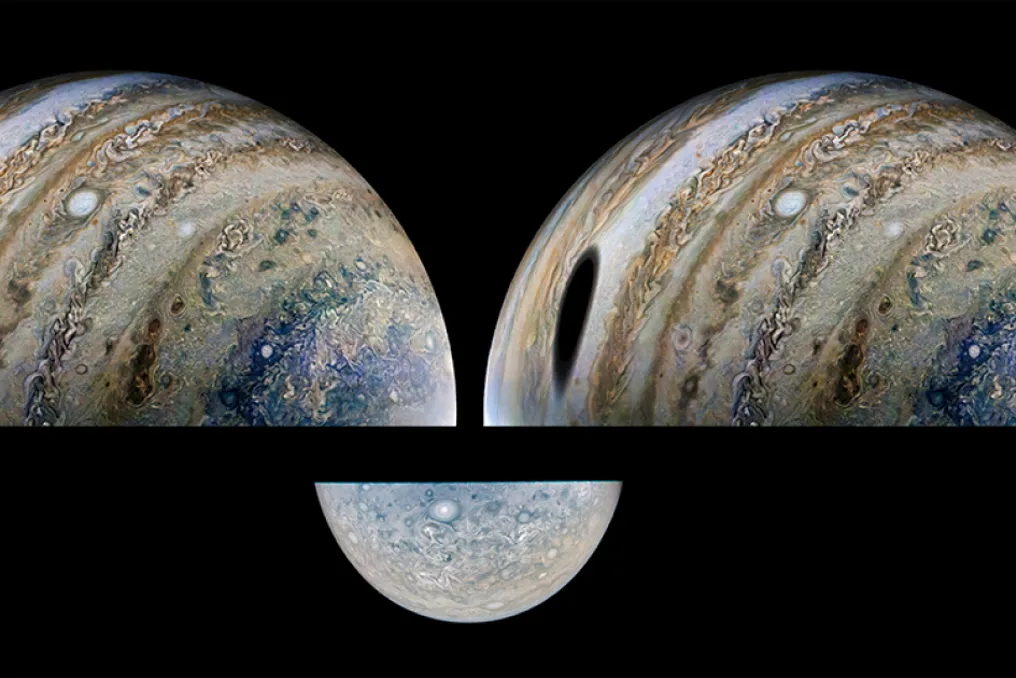
The station captured images of Jupiter's clouds on September 7, 2023, from an altitude of about 7700 kilometers, recording turbulence and storms in the atmosphere, particularly at high northern latitudes near the day-night boundary. Yusonna also deepened the study of the Great Red Spot, increasing the estimated depth: if early estimates were around 240 kilometers, new studies feature values from 200 to 500 kilometers. An important discovery was the ability of electrons in Jupiter's magnetosphere before the bow shock to accelerate to very high energies, which will help in creating more accurate models of cosmic ray acceleration.
In addition, Yusonna recorded bursts of Jovian lightning and managed to capture radio signals from thunderstorm discharges hidden in superstorms. The power of some of these radio signals was comparable to terrestrial lightning flashes, while others exceeded them by a million times. The hypothesis that powerful storms can be accompanied by hail consisting of a mixture of water and ammonia ice was also confirmed. Similar processes are presumably occurring on Saturn, as well as on the ice giants Uranus and Neptune.
Over the years of its operation, Yusonna has faced several difficulties, including the need to enter safe mode and a temporary camera failure due to high radiation levels. However, the station is currently facing a different threat—Earth bureaucracy. The budget plan proposed by the US Congress for NASA in 2027 includes significant cuts to the funding of several active interplanetary missions, which jeopardizes the possibility of continuing the robotic station's operation.
After successfully completing the maneuver to enter Jupiter's orbit, which required 35 minutes of main engine operation to slow down by half a kilometer per second, the spacecraft was captured by the gravitational pull of the gas giant. Now Yusonna functions as an artificial satellite of the Solar System's largest planet, and scientists are preparing to begin the scientific phase of the mission to answer a number of key questions about Jupiter.