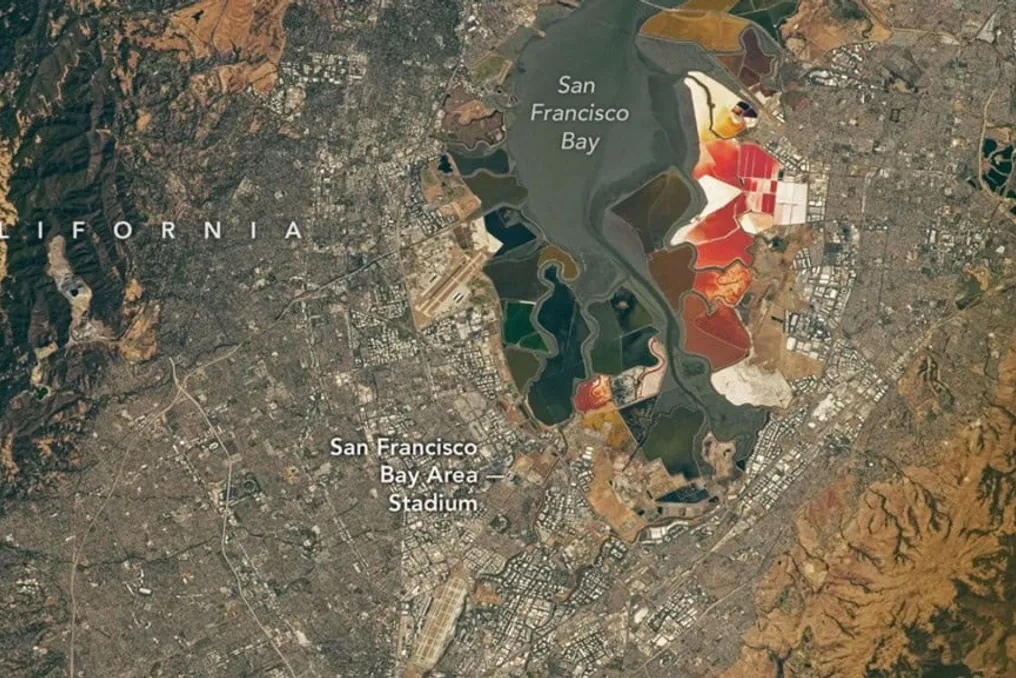
Before the matches of the 2026 World Cup, two North American stadiums were captured from space by astronauts aboard the International Space Station. Recent images published by NASA demonstrate details of the areas surrounding the venues in Santa Clara, California, and East Rutherford, New Jersey.
Details of the terrain from space
These recordings were made in 2022 during Expedition 67 and reveal not only the sports facilities but also the surrounding cities, industrial zones, recreational areas, and ecological regions located near the tournament venues this year.
NASA used these photographs to highlight how astronaut observations can help scientists and the public understand changes on the Earth's surface, including urbanization and environmental recovery processes.
Landscape around the stadiums
One of the photos taken by the astronauts shows the stadium in Santa Clara, California, known as Levi’s Stadium. This arena was completed in 2014 and is surrounded by a mix of residential, commercial, and recreational areas.
The shot was taken on July 26, 2022, and also includes the southern part of the San Francisco Bay. This area is part of a long-term project to restore old salt reservoirs into marshy and tidal zones. The ecological restoration process aims to restore up to 90% of these spaces while preserving elements of traditional salt production in the region. The area captured by NASA represents an intersection of urban development and nature conservation.
The Californian stadium hosted six matches of the 2026 World Cup, including the opening match between Qatar and Switzerland on June 13, and the playoff between the United States and Bosnia and Herzegovina, which took place on July 1.
Situation in New Jersey
Another photo taken by the astronauts depicts the stadium at the Meadowlands Sports Complex in East Rutherford, New Jersey. The recording was obtained on April 17, 2022, and shows the venue near the Manhattan urban area.
The site chosen for the 2026 World Cup final also has a history of intensive human intervention. According to NASA data, this area has undergone deforestation, settlement, expansion of economic and industrial activities, and was used as an unregulated waste disposal zone in the 20th century. In recent decades, the situation has changed due to initiatives to restore wetlands alongside the development of the sports and entertainment complex. The space image illustrates this combination of human transformation and ecological recovery.
In addition to the two stadiums photographed in the United States, other 2026 World Cup venues have also appeared in astronaut recordings and satellite imagery, including locations in Guadalajara, Los Angeles, Houston, and Vancouver.
The photographs were taken using Nikon D5 digital cameras installed by Expedition 67 astronauts. After capture, the files underwent processing, including cropping, contrast correction, and removal of lens artifacts to improve visualization.