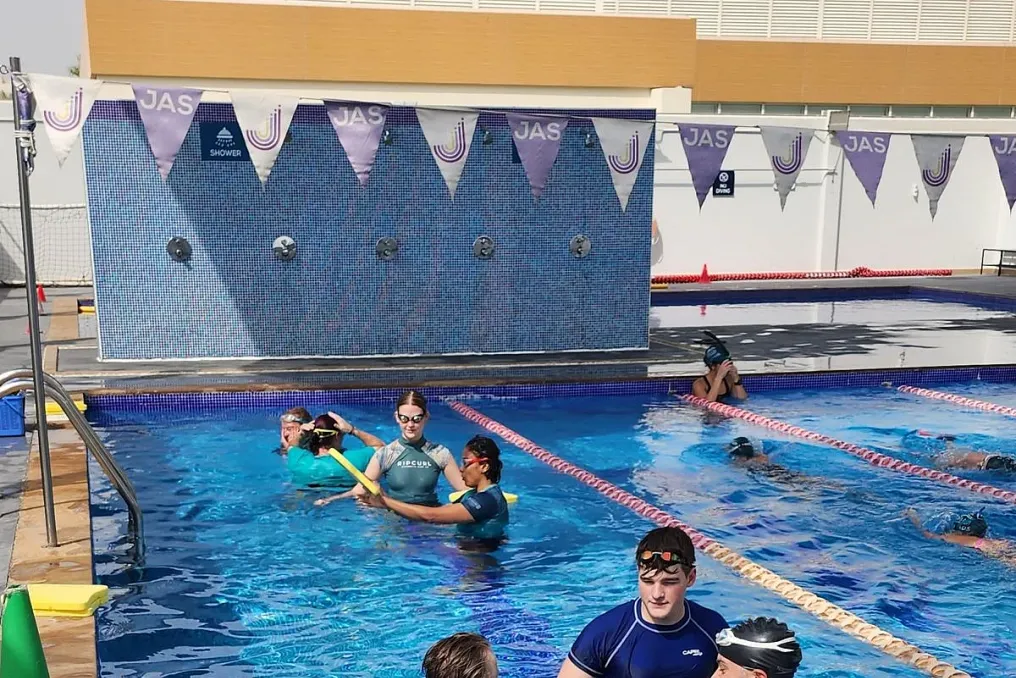
A growing number of students in the United Arab Emirates (UAE) are opting for pools over traditional summer camps. The goal of these sessions is not only training but also mastering skills in teaching, rescue, and emergency response.
}, {A growing number of students in the United Arab Emirates (UAE) are opting for pools over traditional summer camps. The goal of these sessions is not only training but also mastering skills in teaching, rescue, and emergency response.
}, {Several aquacademies have begun offering specialized programs that allow teenagers to gain practical experience in first aid, pool safety, and coaching. These courses help students boost their self-confidence and acquire job-ready skills while preparing for future qualifications.
Urban Training Centre and Urban Swim Academy are leading this initiative. They have developed a pathway for students aged 14 to 17. This program suits those looking for part-time paid work as a swim assistant instructor, wishing to participate in volunteer programs for people with special needs, or planning to become a full-time swim teacher in the future. Furthermore, it serves as a step toward obtaining the STA Level 2 Swim Teaching award from the UK Swim Teacher Association, available from age 16, and is ideal for participants in the Duke of Edinburgh program seeking new skills and volunteer experience.
The course promotes the development of confidence, leadership qualities, and basic life-saving skills in the aquatic environment. Upon completion, participants receive an STA Aquatic Assistant Certificate, an STA Level 2 Safety Award for Teachers (valid worldwide for two years), and an ASHI First Aid Certificate (valid in the UAE, USA, and UK for two years).
Heidi Kurt, General Manager and Instructor at Urban Training Centre and Urban Swim Academy, noted: 'We took this aquatic assistant qualification, which is really designed for a teenager to be in the water under the guidance of a qualified teacher, gain some experience and communication skills, and we combined that with a water rescue course and a first aid qualification.'
The weekly program combines classroom instruction with hands-on water experience, allowing participants to assist qualified instructors while learning about safety, communication, and lesson delivery.
Although teenagers under 16 cannot yet obtain a full swim teaching qualification, this program acts as a stepping stone to professional certifications available later. Kurt explained that participants familiarize themselves with the educational environment and develop skills beyond just swimming.
She emphasized: 'This program is truly a stepping stone to water experience to gain some experience as a teacher, so when they go for the full qualification, they will have at least some water experience and an understanding of how a lesson goes.'
In addition to swimming lessons, students take courses in pool rescue and first aid, enabling them to play a more active role in aquatic centers under supervision. The training is specifically organized around school holidays, ensuring accessibility during breaks and mid-semester. Teenagers spend several hours daily in structured learning sessions while completing practical training and 'shadow teaching' hours.
According to Kurt, students progressing along the assistant path often have a stronger foundation when pursuing professional certifications after turning 16. She added: 'Obviously, a teenager who has a couple of years of experience as a swim assistant before that age will pass many more levels of tests or exams or courses. The basics of swimming for teenagers is a weekly program, half a day for the full swim teacher qualification, including some components done online before coming to class.'
For some students, these qualifications can also support future university applications and employment opportunities. Lawrence Arc Bathe, Managing Director of Urban Training Centre and Urban Swim Academy, stated: 'For example, the Royal Life Saving Society (RLSS) lifeguard qualification earns UCAS points recognized by universities in the UK. It gives you a lot of experience, and you enter university with a qualification and experience to then start earning money.'
Despite the initiative having only launched last year, organizers note a steady increase in interest. Bathe said: 'We certified the first teenagers last summer, and since then we have had teenagers in almost every course we ran.'
Among the program graduates is Bathe's own son, who subsequently began teaching younger children. She recounted: 'He went through this program and worked all year. So throughout his 13th grade, he worked every Saturday morning, giving us lessons, and he achieved great success.'
Bathe added that this experience positively affected not only the young instructors but also the younger swimmers. 'I think the little kids he taught loved having a young instructor. They see him in the water, swimming like a competitive swimmer, and I think they admire him very much.'
Academy leaders note that prior swimming experience is not formally required for some teaching qualifications, but strong swimming skills significantly increase a student's chances of success. Bathe clarified: 'The qualification does not require swimming experience, but statistically, if a person wants to succeed in the qualification, they really must know how to swim. You need to understand the terminology. A person must understand when someone explains what a breaststroke kick is. You have to learn to teach it properly.'
However, lifeguard qualifications have strict swimming standards, including distance swims and endurance checks.
Meanwhile, the academy collaborates with several schools across Dubai, including Jebel Ali School, Dubai British School Mira, Dwight School Dubai, and Greenfield International School, among others, running programs both on school premises and in specialized training centers. Recently, their team conducted a first aid training initiative for 24 tenth-grade students at Safa Community School.
She commented: 'We completed a full first aid course with 24 tenth-grade students, so it was part of their enrichment program for teenagers, and it was a real success for the school.'
Beyond water skills, educators believe these programs help teenagers develop qualities useful throughout life. For Kurt, the value of such programs extends far beyond certificates. 'I think besides qualifications, it's things like communication skills and responsibility, attendance, and readiness. Teaching teenagers these things is as important as the life skills and qualifications they gain.'
As summer camps begin across the UAE, doctors strongly advise parents to pay attention to heat-related illnesses, infections, and early signs of dehydration in two weeks.
Dr. Mohammed Algezuli, a family medicine specialist, emphasized that heat exhaustion and dehydration are the most immediate problems for children in high temperatures. He also noted that respiratory infections and food poisoning are common due to constant switching between hot outdoor weather and air-conditioned indoor spaces. Furthermore, Dr. Rupa Bakhtavachalu pointed to an increase in gastrointestinal and skin infections, which spread easily in public areas and through close contact. Specialists advise children to develop the habit of drinking two to three liters of fluid daily and ensure structured breaks during peak heat hours. It is also recommended to prepare the child's backpack with sunscreen, water, snacks, and first aid supplies.
As the long summer break begins in Dubai, many parents face the challenge of keeping children occupied, active, and learning amidst high temperatures. Summer camps have become a popular solution for families aiming to combine entertainment, socialization, and skill development during the holidays. The landscape of camps in Dubai has become more diverse, offering programs ranging from robotics and artificial intelligence to sports academies and theater workshops. Many camps provide flexible booking options, sibling discounts, and extended hours to meet the needs of working parents. For example, Gogo Village in Al Quoz focuses on younger children (3-9 years old) and offers crafts and creative workshops. For older children interested in technology, Pure Minds Academy is available, focusing on STEM programs, including coding, robotics, and AI.