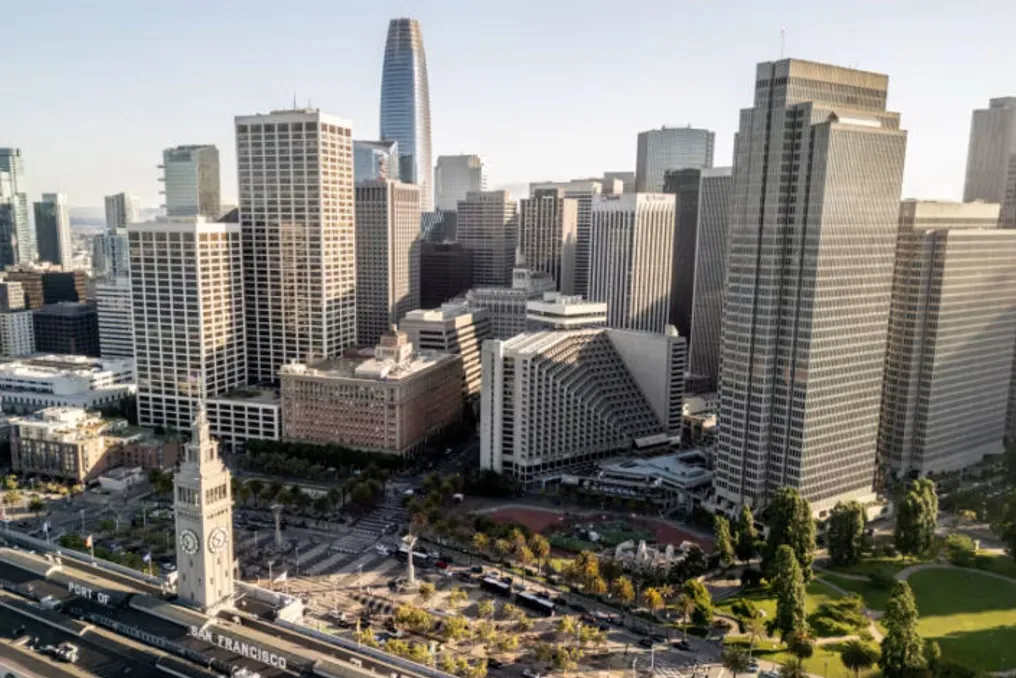
In San Francisco, in the center of Richmond, over two hundred people are on the waiting list for a food bank. This center is located just a few miles west of 'AI Alley,' where major artificial intelligence companies are concentrated, attracting billions in investment and paying high salaries to employees. This, in turn, leads to a sharp rise in housing and rental costs.
Popular
Inequality Amidst AI Growth
San Francisco serves as a stark example of how the rapidly developing AI industry contributes to overall economic growth while masking growing economic inequality among low- and middle-income families. This situation reflects broader national trends in the US.
According to the Department of Commerce, in the first three months of the year, the US economy as a whole demonstrated confident growth at an annual rate of 2.1%, largely driven by increased business investment in AI. However, consumer sentiment remains at historic lows due to wartime price surges. Furthermore, according to the Federal Reserve Bank of Atlanta, the quarter of the population with the lowest incomes showed the weakest wage growth among all cohorts this year.
Comments on Social Consequences
Yves Xavier, Community Programs Director at Richmond Center, told CNN: 'Inequalities in the neighborhood were just growing and growing. We cannot draw a direct line to the impact of AI and say, 'This is exactly it.' But you don't need to be a genius scientist to see how it is expanding inequality in a city that already faces these issues.' He added that demand for the non-profit food bank has increased by about 10% this year.
The Economy of Winners and Losers
The widening gap between the poorest and richest Americans has become a key theme in the US economy, and experts believe AI plays a significant role in this. According to an Oxford Economics report, billions invested in the AI industry have created a group of well-paid workers in tech hubs across the country, including San Francisco, New York, Seattle, Los Angeles, San Jose, and Washington, D.C. These workers are part of the top 10% of wealthiest Americans, whose spending, according to Moody's, accounts for up to 62% of US economic growth.
Manuel Pastor, Director of the Institute for Equality Research at the University of Southern California, noted: 'You see an incredible concentration of wealth resulting from AI for these new companies, their founders, and early employees. It exacerbates the winner-takes-all economy.'
Investment and Threats to Creative Fields
Experts told CNN that today's economic winners are clearly linked to the development and funding of AI, including early investors. SpaceX debuted on Wall Street last month as the largest initial public offering to date. This company, involved in AI and space exploration, is now valued at over $2.1 trillion, and investors expect this to benefit American retirement accounts. AI leaders OpenAI and Anthropic, both headquartered in San Francisco, are also preparing for their own IPOs, which could add trillions in new market value. According to the firm Crunchbase, San Francisco companies account for nearly two-thirds of global AI funding.
Among those losing out are vast segments of Americans, especially recent college graduates struggling to find jobs; low-income individuals who continue to accumulate debt due to noticeable inflation; and creative industry workers, according to Pastor. He emphasized that 'what people put online or in books is privatized by these AI companies, making it harder for those same people to earn a living. This happens to authors, musicians, anyone who is a creative person.'
Impact on Traditional Business
The AI frenzy is also distorting the state of businesses on Main Street. Maxim Darme, Senior Economist at Allianz Trade, observed: 'If you exclude AI, business investment was actually falling, which is quite an unprecedented phenomenon outside of recessions. The technology strongly supports the economy, but at the same time, spending in more traditional areas is shrinking.'
Meanwhile, the gap between broader AI-driven economic growth and the reality of millions of Americans continues to widen. Xavier summarized regarding San Francisco: 'Inequalities here are very, very obvious. It has been a long-standing problem, and I think it just continues to be one.'