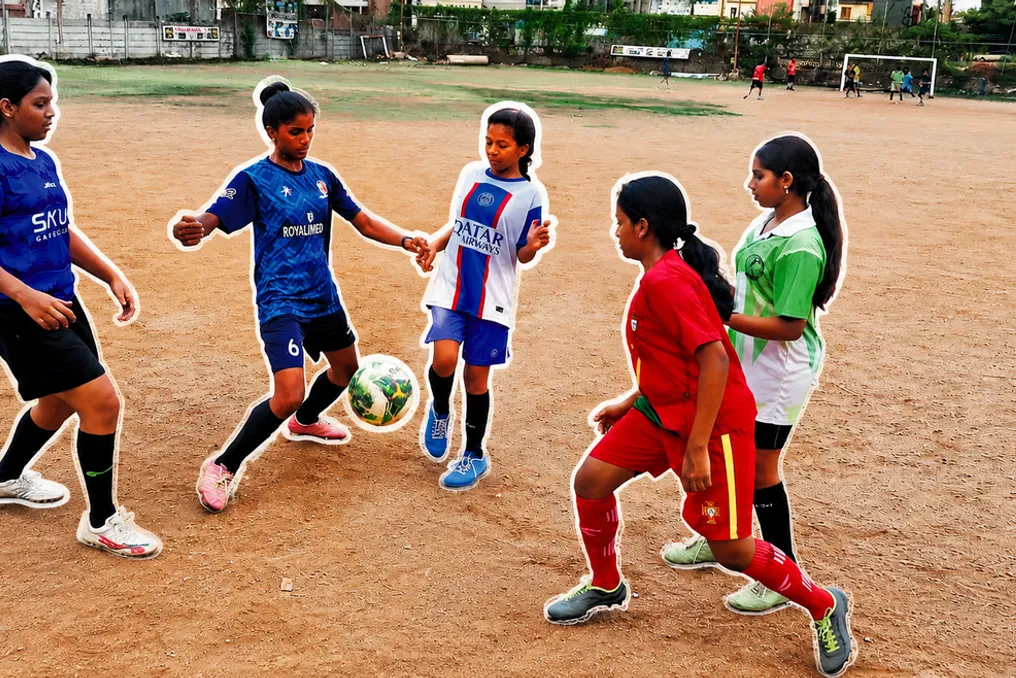
Every evening, about 90 boys gather on the field in Valluvar Nagar, Sainikpuri, Telangana state, to play football. However, upon closer inspection, one can notice the presence of seven to ten girls among them, who confidently hold their ground on a field that was previously exclusively for boys.
The History of 'Mini Brazil' Area
This Tamil-speaking area in Secunderabad has been nicknamed 'Mini Brazil' for many decades. During every FIFA World Cup, flags of Brazil, Argentina, and Portugal are displayed here, and giant images of football stars appear outside houses.
However, the true history of 'Mini Brazil' is not related to the World Cups. It is a tradition passed down from father to son, from coach to student for almost 60 years, and now it is slowly opening up to daughters as well.
The Girl Who Refused to Stand Aside
Before becoming a national-level footballer, Ranganathan Keshavadhi, known to everyone as Mary, was a young girl standing at the edge of the field hoping someone would let her play. She was often rejected, told that there was no place for girls. Nevertheless, she kept coming back.
When she finally got a chance, she seized it, eventually receiving boots, a spot on the district team, and then the opportunity to represent Telangana. Her parents, a footballer father and a former hockey player mother, supported her despite the financial difficulties of tournaments and relatives' questions about why they were sending their daughter onto the football pitch. Inspired by Cristiano Ronaldo, Mary became one of the most famous athletes in the area, distinguished by her sharp skills in evading opponents.
The Wave That Became Ripples
PD Coach Joshua recalls how difficult it was to convince families to let their daughters onto the field before Mary proved herself. He personally spoke with her family to gain their support, and after the results appeared, attitudes in the neighboring area began to change.
Girls who previously only watched from the sidelines started attending training sessions, gradually forming their own football culture. Before the pandemic, about 20–22 girls regularly trained in Valluvar Nagar. Training was suspended during COVID-19, and after resuming, only seven to ten girls returned, as studies and family responsibilities distracted the others.
Those who remained continue this tradition. Suhana, an eleventh-grade student currently representing the Rangareddy district, notes that many girls joined only after seeing Mary's success, and now she encourages her friends to take up the sport. Mamta Ravi, whose two daughters train regularly, believes that sports develop physical fitness, energy, and confidence that extend far beyond the field. Former player Sherli, now working in a multinational corporation, says that parents began to believe in their daughters' potential once they saw that Mary had reached the national level.
The Sixty-Year Relay Race
PD Coach Emmanuel describes the football culture of Valluvar Nagar as a relay race that began in the late 1960s and was passed from senior players to juniors. What started as informal coaching by former players turned into a structured training program conducted by nine certified coaches. Many local residents built careers thanks to sports quotas after training on this very ground.
Emmanuel asserts that the field did more than just raise players. Before the football program developed, some young people in the area were at risk of drug addiction and other negative influences. As soon as they started training regularly, the coaches noticed clear changes, and the field became a place where children learned discipline and spent time productively.
Prospects for Sports Development
Training in Valluvar Nagar is free, funded by former players and community elders who help cover the expenses. The biggest obstacle for young players in the area remains access, not talent. Private academies in other parts of the city can charge from 2 to 4 lakh rupees, making them inaccessible to most local families. Opportunities for girls still lag behind those available to boys, as there are fewer leagues and tournaments for them to participate in. But in 'Mini Brazil', where an entire community has passed down football for sixty years like a family heirloom, the next chapter is being written, and now it is being written by daughters.
Mumbai risks losing one of its most iconic football stadiums—the field named after Neville D'Souza, one of India's greatest football legends.
For many generations of young footballers, this place is not just a playing field, but an area where dreams are formed, talents are discovered, and the future of Indian football begins.
The significance of sporting heritage
The disappearance of playing fields means that cities lose not only open spaces but also opportunities for the development of future athletes, as well as an indispensable part of their sporting heritage.
The article raises the question of whether all cities should make greater efforts to protect their sports grounds.