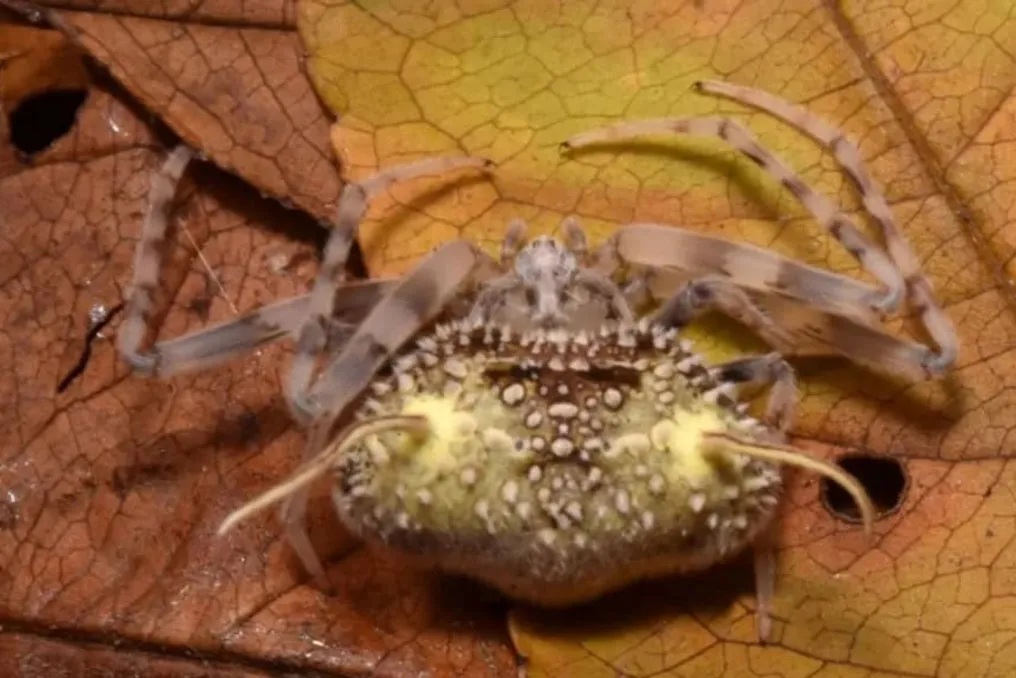
A new species of spider has been discovered in the tropical forests of Ecuador, attracting the attention of the scientific community due to its ability to mimic the appearance of a parasitic fungus that infects and kills other arthropods. This species, named Taczanowskia waska, is the first known to use this method of mimicry.
Researchers described this finding in an article published in the journal Zootaxa after conducting analyses that confirmed it was a previously unregistered species. According to the authors, the camouflage strategy helps the spider both avoid predators and approach prey unnoticed.
This case also highlights the significance of observations made by ordinary citizens and scientific collections. The study was initially initiated by a record on the iNaturalist platform and was later supplemented by comparisons with samples stored in museums.
The organism reproduced by this species is known for turning infected spiders into true 'zombies'. After penetrating the host, the fungus alters its behavior, forcing it to remain in a favorable position for spore dispersal before death, completing the parasite's cycle.
The first encounter with the spider occurred when it was motionless on the underside of a leaf. Its external resemblance to a dead arthropod infected by fungus was so convincing that researchers initially thought they were looking at an infected specimen. Only upon touching it did they realize the animal was alive.
The study authors explain that the light color of the abdomen, combined with small whitish protrusions and two elongated yellowish structures, accurately reproduces the characteristic elements of the fungus genus Gibellula. The scientists noted: 'The pale color of the abdomen with small white protrusions perfectly mimics fungal mycelium. The two stroma-like structures resemble Gibellula formations.' These features make the camouflage highly plausible.
In addition to its appearance, the posture adopted by the species enhances the camouflage. As the researchers describe, the motionless and suspended state under the leaf helps recreate the typical picture of a spider that died after being infected by a parasitic fungus.
The mimicked organism belongs to the genus Gibellula, a group of fungi specialized in infecting spiders. After penetrating through the mycelium, the parasite slowly consumes the host's tissues, and at the end of the process, forms structures responsible for spore dispersal. Scientists suggest that Taczanowskia waska reproduces exactly this final stage of infection. The authors' hypothesis is that this similarity reduces the risk of predator attack while simultaneously facilitating the approach of potential prey.
The existence of this species became known to researchers after publication on the iNaturalist biodiversity registration app. Following this, the team found a specimen in nature and conducted comparisons with materials stored in scientific collections. During this stage, a specimen kept in the Hamburg Museum of Natural History in Germany, collected in Bolivia in 1903, was found. The comparison confirmed that it was a separate species.
Nadine Duperre, a researcher at the Hamburg Museum of Natural History, stated that such discoveries demonstrate the value of scientific collections, as they allow for the classification of new species and their comparison with historical specimens. The researchers also pointed out that additional records on iNaturalist suggest the existence of at least four other spiders mimicking fungal infections, two of which may represent species unknown to science.