The 'Bukhorcha' ensemble from the State Philharmonic of Uzbekistan for Bukhara Region successfully presented national art and culture at prestigious international folk festivals and cultural events in the Republics of Slovenia and Croatia.
The 'Bukhorcha' ensemble from the State Philharmonic of Uzbekistan for Bukhara Region successfully presented national art and culture at prestigious international folk festivals and cultural events in the Republics of Slovenia and Croatia.
The first stop of the tour was the city of Metlika in Slovenia. A concert was organized there for local residents, featuring national songs and dances characteristic of the Tashkent, Fergana, Khorezm, and Bukhara regions, as well as demonstrations of examples of folk oral creativity.
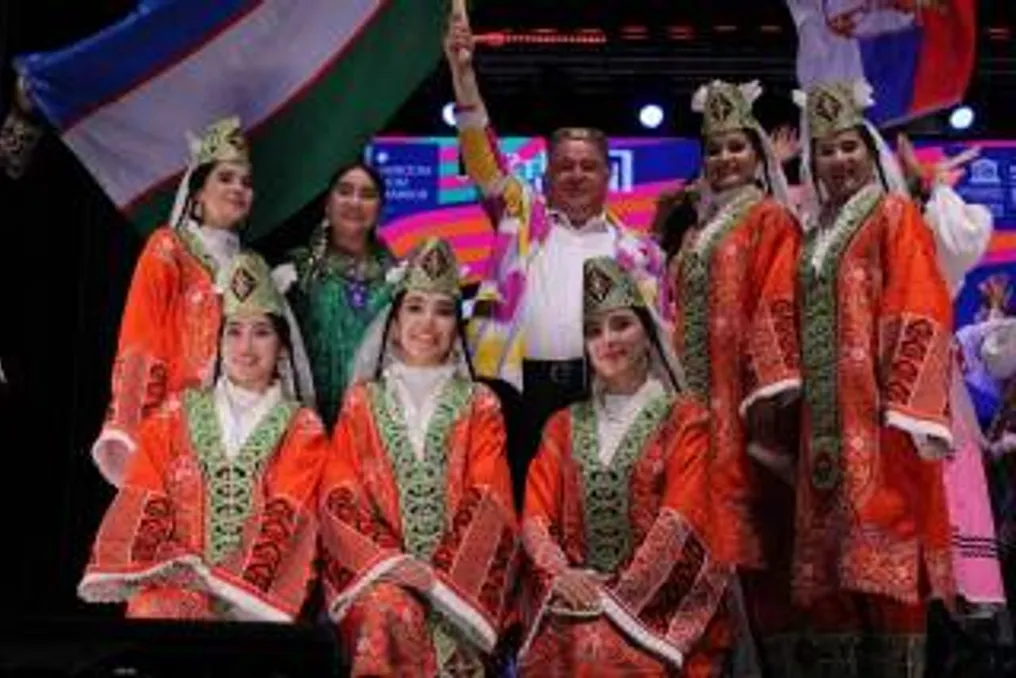
Subsequently, the collective participated in the 38th CIOFF FolkArt International Festival in the city of Maribor. During the festival, street performances were held in the city center and tourist areas. Uzbek artists, together with creative groups from Bolivia, presented national musical and dance programs that were warmly received by guests and local residents. Foreign spectators showed particular interest in Uzbek national dances, traditional costumes, and folk musical instruments.
During the festival, a traditional procession of artists from participating countries took place along the Drava River flowing through Maribor. Representatives from Bolivia, North Macedonia, Poland, Puerto Rico, Uzbekistan, Serbia, and Slovenia participated, showcasing the national culture of their countries.
There was also an official meeting with the Mayor of Maribor, Sasha Arsenovich. The delegation, headed by Bahrom Usmanov, Head of the Department for Concert and Performance Activity Development of the Ministry of Culture of the Republic of Uzbekistan, and Rauf Avezov, Director of the State Philharmonic of Uzbekistan for Bukhara Region, discussed issues of expanding cultural and humanitarian cooperation and developing ties within the framework of international festivals.
A gala concert was held in the city of Murska Sobota, featuring creative groups from Uzbekistan and Bolivia. Artists from both countries demonstrated examples of national music and dance, leaving unforgettable impressions on the audience.
The closing gala concert of the 38th CIOFF FolkArt International Festival took place in Leon Stuckel Square in Maribor. Over 200 artists from different countries participated in this concert, and representatives of Uzbekistan performed on behalf of the continent of Asia, winning recognition and applause from the audience with their national songs and dances.
The tour continued in Croatia. The 'Bukhorcha' ensemble actively participated in events at the XXVII International Folk Festival in the city of Karlovac. According to the festival program, the ensemble held street performances in the central streets and squares of the city, demonstrating the rich traditions and unique appeal of Uzbek national art through the performance of Uzbek folk songs and dances, as well as through the display of exquisite national costumes and folk instruments.
Folk and artistic groups from Madagascar, Puerto Rico, the Philippines, and other countries also participated in this international festival, presenting the rich cultural heritage and national customs of their peoples. The five-day prestigious festival became an important platform for strengthening intercultural dialogue, promoting the intangible cultural heritage of peoples, and developing creative partnerships. The successful participation of Uzbek artists in these events made a significant contribution to enhancing the international prestige of national culture and the wide promotion of Uzbek art on the world stage.
The decisive stage of cotton cultivation has begun in the republic. In this regard, a republican seminar was held via video conference under the leadership of Minister of Agriculture Ibrokhim Abdurakhmonov.
The event was attended by heads of agricultural departments of the Karakalpakstan Republic and regions, district heads, farmers, cluster representatives, as well as specialists and scientists in this field. The seminar discussed the main tasks related to cotton care, pruning, irrigation, feeding, effective use of macro- and microelements, preparation for defoliation, and harvesting without losses. Specific assignments were given to the responsible individuals.
It was emphasized that one of the most important tasks today is to achieve a maximum stem height of 95 centimeters by August 1st, as well as forming 8–10 full bolls on each plant and preparing them for picking. It was also noted that in the current climatic conditions, every day of July is extremely important. According to the minister, wasting time during this period can negatively affect further development.
The meeting focused on ensuring normal cotton growth, timely pruning, coordinated organization of irrigation and feeding work, and the use of microelements based on scientific recommendations alongside mineral fertilizers. Furthermore, the necessity of strengthening weed control and applying herbicides while strictly adhering to agrotechnical requirements was highlighted.
The minister also warned that spraying preparations on open cotton flowers is unacceptable, as it can lead to damage and sterilization of these flowers. Special attention was paid to the widespread adoption of biological fertilizers and biopreparations, as well as strengthening cooperation between scientists and farmers. Ibrokhim Abdurakhmonov insisted that farmers and clusters must organize agrotechnical measures based not on personal experience but on scientifically substantiated recommendations. He noted that the main task of science is to achieve practical results and serve the farmer.
As a result of the seminar, relevant tasks were established, including starting the 'aging' of cotton from August 1st using ethephon, conducting two defoliation events in August, carrying out desiccation in September, preparing for cotton harvest, daily monitoring in every field, and the widespread implementation of scientific recommendations in practice.
At a meeting in Termiz, attended by the head of the Surkhandarya region, Ulugbek Qosimov, and the chairman of the Tax Committee of the Republic of Uzbekistan, Farrukh Polatov, the appointment of Akmal Valiev to the position of head of the regional tax service was announced. Previously, Akmal Valiev worked as deputy head of the tax service of the Samarkand region starting in 2024. This appointment took place as part of events held in Termiz.
In recent years, the decentralization of state governance in Uzbekistan and the direct delivery of services to mahallas, as well as decision-making at the lowest level of society based on the principle of 'human dignity,' have become the main directions of systemic reforms.
The mahalla is no longer just a self-governing body; it has become a unique institution of civil society responsible for solving social problems of the population, supporting entrepreneurship, and defining the moral and legal environment of the region.
It is necessary to recognize the decree of the President of the Republic of Uzbekistan adopted in December 2023, titled 'On measures to fundamentally enhance the role of the Mahalla institution in society and ensure its functioning as the first link in solving people's problems,' and the resolution 'On launching the activities of the Association of Uzbek Mahallas and taking additional measures to improve the governance system in mahallas' as an important step in perfecting the mahalla system.
Based on these documents, the previous 'mahalla council' composition was expanded, leading to the emergence of the 'mahalla seven-member' institution with the inclusion of a tax inspector and a social worker. This change is a profound renewal not only in number but also in substance.
Currently, the deputy mayor under the head of the mahalla, youth leaders, women activists, prevention and tax inspectors, and social workers work as a single team. This system allows for the coordination of areas such as social protection, poverty reduction, employment provision, and encouragement of economic activity based on the 'one-window' principle. At the same time, a legal and organizational basis has been created for state services to be provided to the population in an even easier, faster, and more convenient form.
As part of the ongoing reforms, 2026 has been declared the 'Year of Developing the Mahalla and Advancing Society.' Within this year's State Program, the practice of appointing 'seven-member' members from the local population or nearby areas in 500 mahallas is increasing the popular nature of the system. Furthermore, strict rules regarding the exemption of employees from unnecessary meetings and assignments are serving to increase the efficiency of their activities.
Today, the mahalla is a technologically equipped area. The 'Digital Mahalla' electronic platform integrates all links, from the mahalla head to the deputy mayor, into a single system. Through this platform, the population can submit their appeals online and monitor their execution in real-time. This system reduces bureaucracy while creating the possibility of objectively evaluating employee performance based on key performance indicators (KPIs), which increases the responsibility of each employee.
According to data from the Association of Uzbek Mahallas, many activities were carried out in 2025 in 8,992 mahallas with over 55 thousand 'seven-member' employees and nearly 1 million participants. In the scope of these activities, 2,090 (23%) mahallas were turned into unemployment-free areas. Additionally, poverty decreased sharply in 1,435 (16%) mahallas, and the crime rate was lowered and a safe environment was created in 4,388 (49%) mahallas.
It should be specifically emphasized that the work carried out to ensure the employment and social rehabilitation of 428 thousand migrants returning from abroad demonstrates what an important social force the mahalla is.
Another strategic direction of the reforms is the financial independence of the mahallas. Based on the presidential decree, 15% of the funds collected from property and land taxes will be directed to funds for solving the socio-economic problems of the mahalla directly. Increasing transparency in the use of mahalla funds and fully delegating decision-making authority to mahalla councils is set as a priority task in the 2026 Reforms Program.