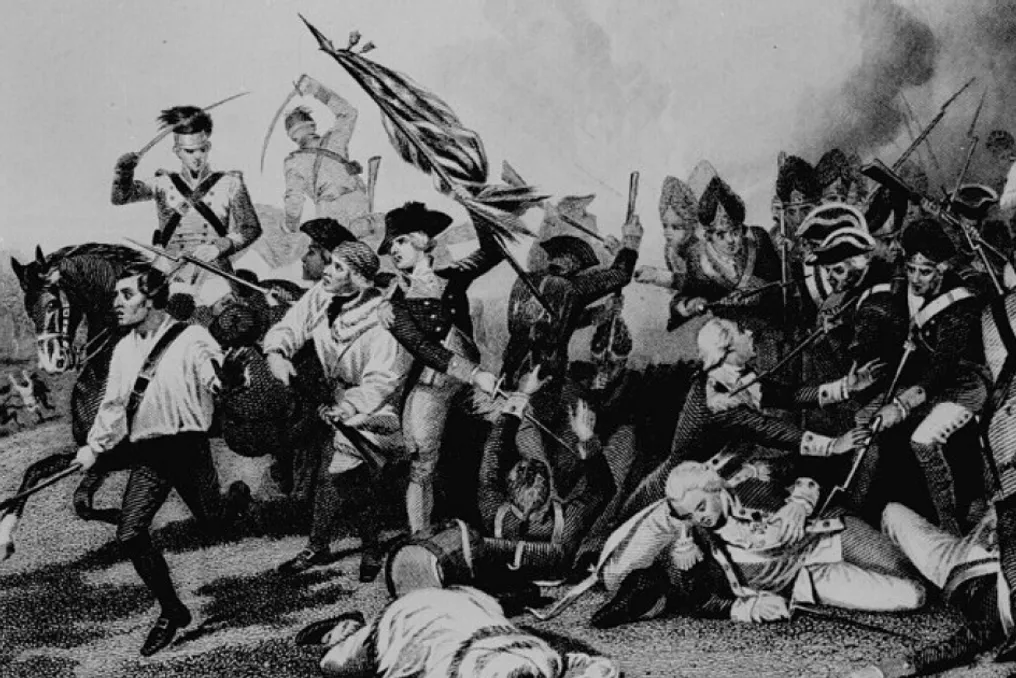
American researchers were able to identify the remains of a soldier who fell during the Battle of Camden in 1780 using genetic analysis methods. It was determined that the previously found skeleton belonged to private John Pamfry, who served on the Continental Army side.
Popular
Context of the War of Independence
The period from 1775 to 1783 was marked by the American War of Independence. Within this conflict, thirteen colonies rose up against British rule, forming a sovereign state—the United States of America.
The situation in this bloody war was not always favorable to the victor. Specifically, on August 16, 1780, the Continental Army suffered one of its heaviest defeats at the Battle of Camden. This city is located in modern-day South Carolina. As a result of the battle, the British lost about three hundred people, while the Americans, despite having numerical superiority, lost approximately two thousand fighters. Today, the site of the battle is a National Historic Landmark for Americans.
Discovery and Analysis of Remains
Several years ago, American archaeologists, including James Legg from the University of South Carolina and Steven Smith from the South Carolina Institute of Archaeology and Anthropology, conducted work on the grounds of this landmark. They discovered fourteen presumed victims of the battle: twelve of them apparently fought for the Continental Army, and two were Loyalists or soldiers of the British Army. The scientists decided to identify the deceased by DNA analysis, for which the remains were sent to the University of South Carolina and the company 'FHD Forensics' in 2022.
Identification of John Pamfry
Nancy White, 71 years old, who was part of the group of modern people involved in the research, turned out to be a distant and indirect relative of one of the fallen soldiers. Genomic research confirmed that this soldier was John Pamfry. He enlisted in the Seventh Maryland Regiment of the Continental Army in 1777 as a young man. According to historical documents, Pamfry participated in several battles, but his death occurred at the Battle of Camden.
Researchers established that the fatal blow to Pamfry came from a bullet fired from a British musket in August 1780. After the battle, he was buried in a shallow grave. For Mrs. White, this news about her relative's fate was a surprise, as her ancestry is linked to the Quaker Protestant movement, whose principle is pacifism. It is assumed that Pamfry abandoned the beliefs of this society after the early loss of his parents and joined the military.
Other Scientific Discoveries
Scientific assumptions about the origin of remains are sometimes incorrect. For example, researchers recently analyzed the DNA of a person missing in Israel in the mid-last century, but their genome showed that the bones belonged to a person from a different population than the missing man.
Furthermore, geneticists studied the DNA of two adult individuals buried in the same grave in the Polish city of Opole during the Middle Ages. Although the archaeological context might have indicated a familial relationship, researchers concluded that they were two adult women who were not close biological relatives. The reason for the joint burial remains unknown, which the scientists reported in an article published in the Journal of Archaeological Science: Reports.