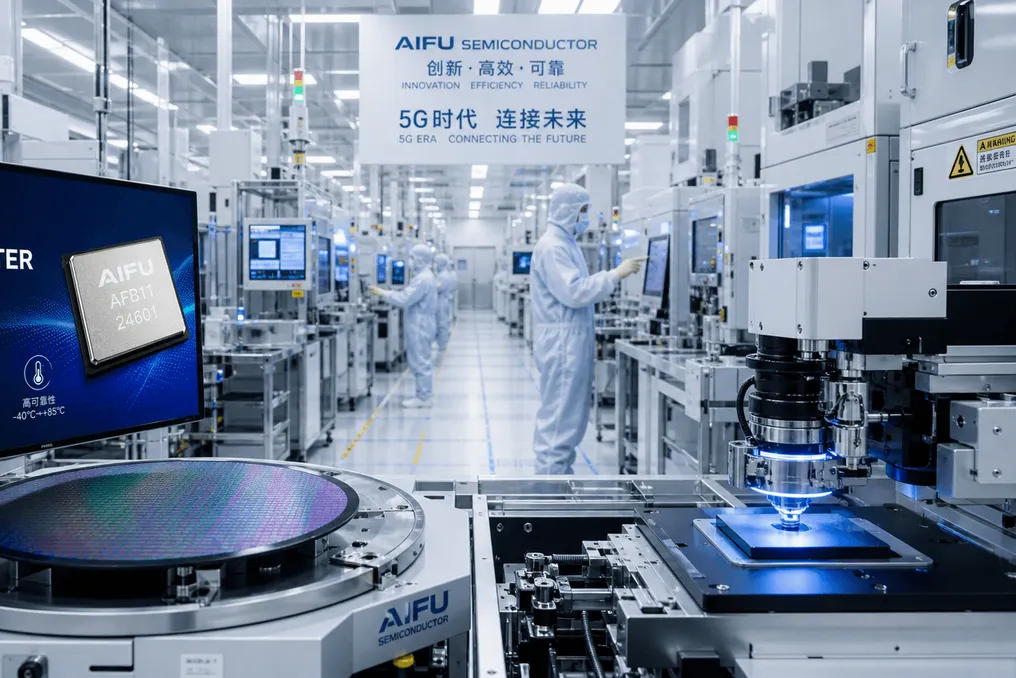
AIFU Semiconductor, based in Guangzhou, is increasing its production of BAW filter chips to one billion units. This allows it to enter a market previously controlled by Broadcom and Qorvo in the 5G radio frequency filter segment, utilizing patented aluminum nitride single-crystal technology.
AIFU Semiconductor is the only company in China and the third globally to master the complete production chain for BAW filter chips for medium and high-frequency 5G bands. The company aims to achieve an annual production capacity exceeding one billion chips, with a stable yield rate of 98–99%. The company's products are already integrated into the production lines of major terminal manufacturers such as Samsung and ZTE.
BAW chips serve as key elements in the radio frequency front-end systems for 5G and higher networks, directly influencing signal reception quality and the ability of smart terminals to resist interference. Previously, American firms Broadcom and Qorvo effectively monopolized the markets and patents for 5G filters. AIFU Semiconductor managed to overcome this barrier by developing its own technology based on aluminum nitride single crystal (ScAlN), bypassing patent restrictions related to polycrystalline aluminum nitride established by foreign giants.
Unlike the polycrystalline aluminum nitride used in the industry, aluminum nitride single crystal provides superior piezoelectric characteristics and acoustic wave transmission efficiency, making it an ideal material for high-performance BAW filters. The company built the world's first 8-inch mass production line for BAW chips in Guangzhou. In 2015, AIFU Semiconductor launched a pilot 5G SABAR BAW line with a monthly capacity of 500,000 units. By 2020, it expanded production to 30 million units per month. Today, the company maintains stable mass production of nearly 100 chip models.
Thanks to systematic technological breakthroughs in materials, simplification of chip manufacturing processes, and domestic raw material supply, the company has achieved a 30–40% reduction in overall production costs compared to foreign counterparts. Meanwhile, SABAR chips demonstrate an improvement in key performance indicators of more than 20%. One smartphone typically requires over 30 filters covering various frequency ranges, and AIFU Semiconductor's products now support frequencies above 10 GHz. The company has upgraded about 12 sets of semiconductor equipment to support its patented process, with some core components developed in-house. The company's 50 mu (3.3 hectares) headquarters in Guangzhou has completed construction and is undergoing cleanroom equipping.
In addition to mobile communications, AIFU Semiconductor's high-frequency filters are used in satellite internet, Internet of Things (IoT), and automotive communication. The company sees robotics as the next frontier for growth, as robots transition from pre-programmed control to autonomous environmental perception, which requires intensive interaction with wireless signals. Furthermore, the company plans to bring its SAMES sensors to the industrial inspection and automotive electronics markets, aiming to double revenue this year.