Synthetic plastics have long dominated global production due to their strength and low cost, finding applications from packaging to auto parts. However, their long decomposition period leads to accumulation in landfills and oceans, damaging ecosystems. Plastics reinforced with synthetic fibers, such as fiberglass or carbon fiber, are difficult to recycle and heavily rely on non-renewable and depleting fossil fuels.
Searching for sustainable alternatives
The urgent need for eco-friendly substitutes has prompted scientists and engineers to focus on biodegradable composites made from natural fibers. Researchers are creating new materials by mixing agricultural waste, fast-growing local grasses, and recycled polymers. These materials can enhance the mechanical strength of traditional plastics while significantly reducing environmental impact.
Innovations in Composites
Aparna Singh, a professor at the Indian Institute of Technology (IIT) Bombay, notes that using such composites increases the proportion of biodegradable component in the matrix and also makes the fibers more accessible compared to thermoplastics. She emphasizes that adding these natural fibers substantially improves the strength and viscosity of the composites.
Professor Singh, along with her student Nitin Kumar Arya and the team at IIT Bombay, is actively developing sustainable composite materials. Their patents demonstrate progress in this technology. They have created numerous new, environmentally friendly materials by combining common plastics with biodegradable substances like Munja grass and Bermuda grass. These green composites feature increased strength, durability, lightness, economic efficiency, and high recyclability, marking a transition towards a circular economy.
Advantages of Local Grasses
According to Professor Singh, while many studies focus on commercial natural fibers such as hemp, flax, or jute, their work demonstrates the engineering potential of abundant local grasses that have been little studied for use in advanced polymer composites.
Previously, innovations in eco-composites often required complex and expensive recipes, as well as large amounts of chemical compatibilizers, dispersants, and synthetic binders to ensure adhesion between natural fibers and plastic. Professor Singh's work eliminates much of this toxic complexity. Her team has developed eco-friendly methods for combining plastic with fibers, securing several patents. Their research utilizes abundant local grasses—Saccharum munja (Munja grass) and Cynodon dactylon (Bermuda grass)—to reinforce epoxy resins, high-density polyethylene (HDPE), polypropylene (PP), and biodegradable polymers such as polylactic acid (PLA), with the resulting materials outperforming traditional ones in characteristics.
Manufacturing and Testing Methods
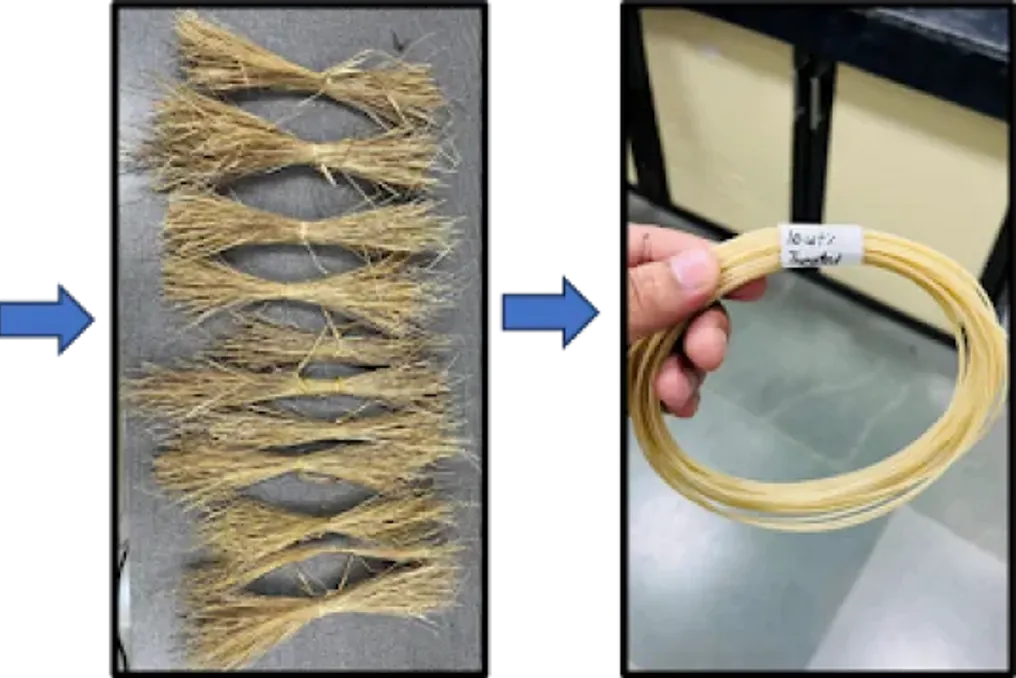
Professor Singh's team developed a method to mix finely chopped Saccharum munja fibers directly with HDPE granules without using any chemical binding agents. The composite components are passed through an extrusion molding apparatus to create high-strength, eco-friendly parts that are significantly cheaper and lighter than traditional fiberglass composites.
Another invention uses Bermuda grass. Although often considered a fast-growing weed, its dense, fibrous structure makes it an excellent reinforcing agent. Treating Bermuda grass with a simple alkaline solution (sodium hydroxide) removes natural waxes and impurities, ensuring strong fiber adhesion to HDPE. The resulting material exhibits tensile strength far exceeding that of pure HDPE.
Professor Singh points out that natural fibers inherently have hydrophilic surfaces, whereas HDPE is hydrophobic. This mismatch usually leads to poor fiber-matrix adhesion, inefficient stress transfer, and degraded mechanical properties. Achieving strong interfacial bonding without heavy reliance on expensive compatibilizers was a major challenge.
Industrial and 3D Printing Applications
For heavy industrial needs, researchers patented a high-performance composite of Munja fibers and epoxy resin. Moving away from molten plastics, this invention incorporates Munja fibers into fabrics and impregnates them with curing epoxy resin using vacuum-assisted molding techniques. The result is an impressive 40% increase in tensile strength, allowing the wild grass and resin composite to compete with synthetic fiberglass.
In a recent study, the team solved a problem related to another common manufacturing process—3D printing. Printing pure HDPE is extremely difficult due to the plastic's shrinkage and deformation upon cooling. Nitin Kumar Arya explains that HDPE is known as one of the most challenging thermoplastics to process via FDM-based 3D printing due to high thermal shrinkage and warping during cooling, which often results in poor layer adhesion and part failure. Overcoming this obstacle was a primary goal of the research.
The IIT Bombay team developed a new filament for 3D printing containing between 5% and 40% Munja grass. As he adds, the fibers possess a lower coefficient of thermal expansion than HDPE. This means that, unlike plastics, they do not undergo excessive expansion or contraction when heated. When mixed with HDPE, the fibers act as a scaffold for the plastic, preventing its deformation during printing. Proper tuning of extrusion parameters and print bed temperature allows this composite to print flawlessly, enabling rapid prototyping of strong and sustainable parts.
Commercial Prospects and Conclusion
The commercial application of these recently patented materials is extensive, covering many major global industries. Since these natural fiber composites are very light yet rigid, they can be used in the automotive industry for fuel tanks, interior panels, dashboards, and bumpers. In India, where stricter rules regarding vehicle disposal and lifecycle are in effect, plastics must either be efficiently recycled or manufactured using sustainable materials with high natural fiber content.
At home, they are ideal for eco-friendly building panels, structural elements, temporary construction shields, and high-quality furniture such as chairs and tabletops, without rotting from termites or moisture. For consumer goods and packaging, they can replace disposable or hard-to-recycle plastic. These composites can be molded into durable household items, reusable tableware, and eco-friendly packaging.
Nitin concludes that the research successfully demonstrated the feasibility of using the same natural fiber system in injection molding, fused deposition modeling (3D printing), and vacuum forming (VARTM). This broad compatibility of processes significantly enhances the industrial scalability and commercial potential of the developed composites.
As the world urgently seeks ways to reduce carbon emissions and decrease dependence on synthetic, non-recyclable materials like carbon or glass fiber, green manufacturing is becoming essential. By transforming ordinary, fast-growing wild grass into a reinforcing agent for recycled plastics, scientists are paving the way for cheaper and greener production. This grass-reinforced plastic brings us closer to a future of truly sustainable manufacturing, from lightweight automotive parts to eco-friendly product packaging.