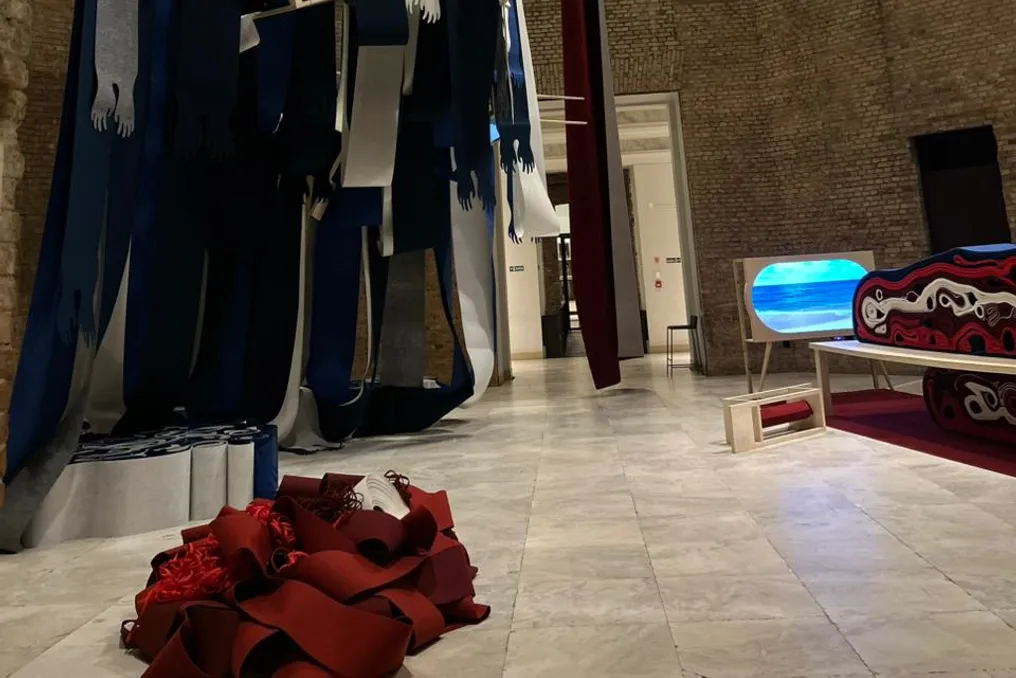
The installation titled 'Mother Gazes at the Sea' by Christiane Salgado has transformed the octagon of the São Paulo State Pinacoteca into a landscape where body, home, and sea share a unified movement of waves.
Description of the Artwork
At the center of the exhibition is a monumental body formed from wavy layers of felt, resting on a chair and extending over a dining table. A television in front of it displays slowly breaking waves on a beach. Furthermore, long strips of blue and gray felt hang from the high ceiling of the octagon, creating a vertical structure reminiscent of a powerful surf.
The motif of the wave runs through the entire work: it is present in the seascape on the television screen, in the rolled layers of felt that constitute the sculptural body, and in the suspended structure occupying the center of the space. Thus, the body, the landscape, and the matter share the same formal principle—the rhythm of the waves.
Popular
Salgado's Creative Approach
Since the 1980s, Christiane Salgado has created works deeply connected to the body and the atmospheres of domestic space. In many of her works, she uses everyday objects, such as chairs, tables, or beds, as structural elements of spatial situations that connect memory, inner world, and imagination. In the installation presented at the São Paulo Pinacoteca, this exploration takes on a larger scale, interacting directly with the architecture.
Occupying the monumental space of the museum, the artist establishes a connection between the domestic interior and the seascape, uniting architecture, textile material, and image in one perceived environment.
The Concept of the 'Uncanny Familiar'
Curator Renato Menezes notes in the exhibition text that the female body is a recurring axis in Salgado's work. According to his interpretation, these bodies function as fields of symbolic condensation, capable of uniting memories, landscapes, and experiences associated with daily life. From this perspective, familiar objects become devices of perceptual transformation, elevating the mundane to the dimension of strangeness. This ambiguity brings the work close to Freud's concept of the 'uncanny familiar' (Unheimlich).
In his essay on this topic, Sigmund Freud describes this term as what arises when something deeply known, belonging to the space of home and intimacy, suddenly becomes alien. The familiar ceases to provide stability and begins to reveal hidden zones of meaning.
Interaction of Interior and Landscape
In Salgado's installation, this tension manifests in the very organization of the space. The table, chair, and television are recognizable objects. However, the body lying on them blurs the boundaries between figure and landscape. Its wavy layers resemble geological formations or sea movements, bringing anatomy and territory closer together. The television introduces another level—a mediated landscape. The sea is not physically present in the space; it appears as a transmitted, distant, and repeating image. Nevertheless, its presence materially resonates within the composition of the work. The rolled forms of felt continue the movement of the waves on the screen, as if the seascape penetrates inside the home.
This continuity between the internal and external can be viewed through the lens of Emanuele Coccia's reflections in the book 'Philosophy of Home' (2022). According to the Italian philosopher, home is not merely an architectural structure but a general atmosphere in which bodies, objects, and images coexist and mutually transform. Life in the home means participating in an environment where the internal and external cease to be opposites and form a single environment of experience. Christiane Salgado's installation operates in this hybrid territory. The sea shown on the television finds resonance in the waves of the felt body. The seascape resonates in the material of the work, transforming the domestic space into a field of formal correspondences.
Architectural Scale and Perception
These relationships become even more significant when considering the architectural scale of the octagon. Thanks to its huge high ceiling and centralized layout, the space demands interventions capable of engaging with its verticality. The felt strips descending from the ceiling directly respond to this condition, reorganizing the visitor's perception and introducing an axis running through the entire environment. Walking around the installation, the viewer experiences an alternation between closeness and expansion. Between these scales of the intimate and the monumental, the work constructs a spatial route that encompasses the visitor and emphasizes the power of this endeavor in the broader context of recent spatial interventions.
Connection to Generative 80
In the historical context of so-called Brazilian art Generative 80, Christiane Salgado's work echoes the period marked by the expansion of painting, sculpture, and installation languages. The recent exhibition Fullgás – Visual Art and the 1980s in Brazil, curated by Rafael Fonseca, confirms this reading, offering a broad overview of the period and demonstrating the diversity of research that emerged at that time. In this context, her work stands out for its constant study of the interconnections between body, domesticity, and space.
There is also an interesting symbolic aspect: Salgado becomes the 80th artist to occupy the octagon of the Pinacoteca, coinciding with her own historical link to Generative 80. This chance convergence hints at a continuity between different stages of the artist's trajectory and the recent history of Brazilian art.
In 'Mother Gazes at the Sea,' gazing and transformation become inseparable actions. The sea acts as a persistent, repeating image on the television screen and in the waves of the textile material. At the same time, the mother's body seems to absorb this movement, becoming the landscape itself. Between home and ocean, the installation creates a space where the inner world and the outer world cease to be opposites. The sea remains before the mother as a stable, repeating image on the screen and in the material waves. By gazing at it, the body seems to recognize in it something that has always belonged to it: the continuous movement of the waves.