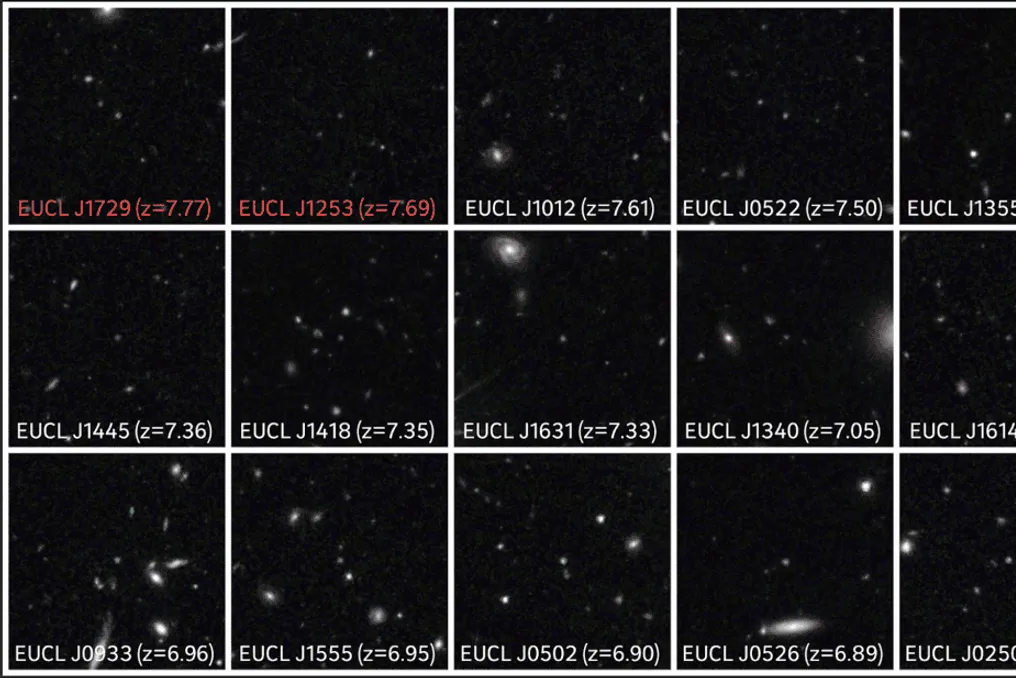
An international group of researchers, including scientists from the University of Michigan (USA), used the European Space Agency's (ESA) Euclid space telescope to discover 31 of the oldest quasars ever observed.
The Epoch of Reionization and New Discoveries
These quasars are so ancient that they belong to the so-called epoch of reionization of the Universe, a period when the first stars, galaxies, and supermassive black holes formed. The research results were published in the journal Astronomy & Astrophysics.
Co-author of the new study, Jinyi Yang, an assistant professor at the Department of Astronomy at the University of Michigan, noted: 'This is truly exciting.' She added that these bright quasars, radiating from the depths of the epoch of reionization—the last major transition in the history of our Universe—provide valuable information on how the cosmos emerged from darkness and how the first supermassive black holes formed.
What are Quasars?
Popular
Quasars are among the brightest and most energetic objects in the Universe. They are powered by supermassive black holes that accrete matter at the centers of galaxies. Although their lifespan is short compared to the lifespan of a galaxy, during this relatively brief period, they can shine hundreds or thousands of times brighter than the rest of their host galaxies.
The discovery of the most distant quasars allows astronomers to study the primitive Universe. However, ancient quasars are rare because few galaxies have had time to grow large enough to host them. Furthermore, they are difficult to find because their initial light is faint and easily masked by stars.
The Role of the Euclid Telescope
According to co-author Feige Wang, a research scientist in astronomy at the University of Michigan, the Euclid mission, which began its cosmological survey in February 2024, opens a new chapter in these searches. He stated: 'The Euclid mission is a complete game-changer.'
Among the 31 discovered quasars, 12 have a redshift greater than 7, more than double the number of known quasars with such a high redshift.
Redshift is a measure of the stretching of the wavelength of light from an astronomical object due to the expansion of the Universe. The longer the light travels to us—that is, the farther away the source and the earlier it was emitted—the greater its redshift will be. Thus, observing objects with high redshifts allows astronomers to look back in time and study the Universe in its younger state.
Previously, the record for the most distant quasar belonged to a discovery made by Wang and Yang in 2021, with a redshift of 7.64. The new study includes two quasars that broke this record: one with a redshift of 7.69 and another with 7.77. This means both appeared within 670 million years after the Big Bang, and their light reached us more than 13 billion years ago.
Unprecedented Survey Depth
A distinguishing feature of Euclid is its unprecedented combination of depth and sky coverage. This allows the space telescope to detect quasars that are ten or a hundred times fainter than those found in previous wide-field surveys.
Damin Yang, the lead author of the study and a PhD student at Leiden University (Netherlands), called Euclid a 'unique tool for quasar hunting.' He explained that previously, only a small number of the brightest ancient quasars could be found, whereas Euclid allows for a much more efficient search in larger areas of the sky to capture fainter light.
Although Euclid accelerates the search for ancient quasar candidates, astronomers also rely on a number of other telescopes and instruments to confirm and characterize these objects. For example, the teams of Jinyi Yang and Wang, including University of Michigan postdoc Xianyu Jin, used the Magellan Telescopes at the Las Campanas Observatory in Chile to analyze candidates found by Euclid. They confirmed ten of the 31 quasars discovered in this study.
Future Research Directions
Going forward, they and their colleagues from the Euclid Consortium—comprising 2,600 participants from 18 countries—will continue the search for older and more numerous quasars to answer questions about the primitive Universe.
Yang's team is investigating how these first supermassive black holes grow and how they influence the evolution of their host galaxies. Wang's team is studying the large-scale environments around these quasars, considering their place in the cosmic web of galaxies.
The recently discovered quasars may also serve as reference points for the Extremely Large Telescope (ELT) when it becomes operational, which is planned for 2029. This 39-meter telescope will be the world's largest operating in visible and infrared light, with the University of Michigan being the only US university involved in its design and construction.
Yang emphasized: 'We want to answer questions about how these quasars formed, what black holes spawned them, and how they grew.' She added that current observations of distant quasars challenge existing models of black hole genesis and initial growth. 'Every time we get new observational data on new quasars, we can place increasingly stringent constraints on these models.'
Euclid will soon receive additional reinforcements in this new era of quasar discovery. The Vera C. Rubin Observatory began its sky survey last year from a peak in Chile, using the world's largest camera. And the Roman Space Telescope is scheduled to launch on August 30, boasting a field of view 100 times larger than the Hubble Space Telescope.
Wang concluded: 'Essentially, next year we will have three truly powerful telescope surveys, and they will allow us to advance in the field of redshift.' He noted that achieving a redshift of 9 might take several years, but he believes a redshift of 8 can be seen very soon.