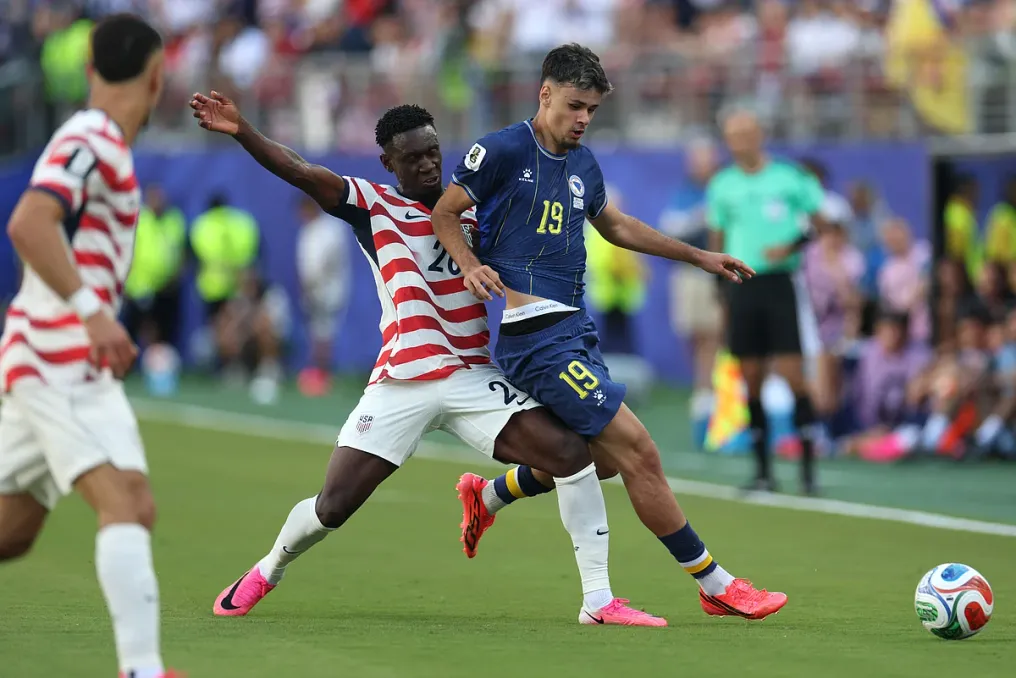
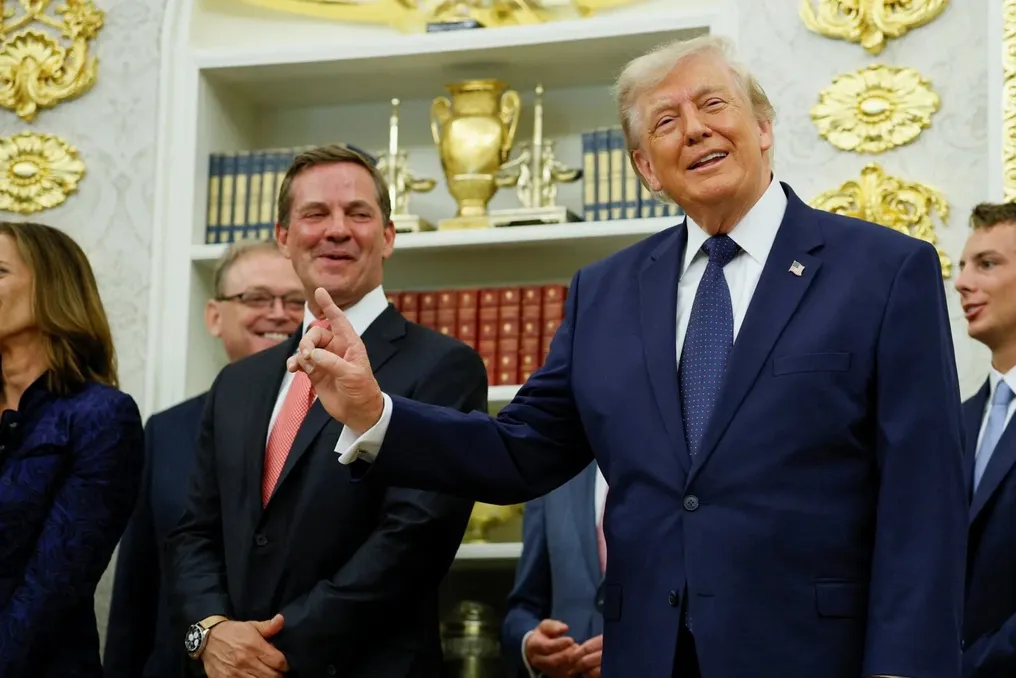
US President Donald Trump confirmed on Monday that he personally contacted FIFA President Gianni Infantino to ask him to review the red card issued to one of the bright stars of the American national team, Folarin Balogun, last week.
FIFA's Decision and Reaction
On Sunday, FIFA surprised the sports world by overturning the red card and giving Balogun a one-year probationary period, using the rarely applied Article 27 of the FIFA Disciplinary Code. This regulation is often called the 'Cristiano Ronaldo Rule' because the FIFA disciplinary committee is notorious for applying this article in November of last year, ensuring Ronaldo's participation in Portugal's starting matches at the 2026 World Cup.
This move once again drew attention to how closely FIFA has collaborated with the US President over the past year, striving to ensure the smooth and profitable staging of the tournament.
Infantino's and Trump's Stance
Shortly after Trump's statements, Infantino issued his own statement, emphasizing that while he regularly communicates with heads of state regarding the World Cup, 'the FIFA judicial bodies are independent. They act autonomously.' The FIFA President wrote: 'I read the decisions of the FIFA Disciplinary Committee when they are made. Sometimes I am surprised by them. Sometimes I agree with them, and sometimes I disagree. However, I always respect these decisions.'
Trump insisted that there was no initial foul. 'I am a person who loves sports and was a good athlete, and I understand sports very well—very well—and it was not a foul. It wasn't even a violation; it was two guys running at full speed who accidentally bumped into each other,' Trump told reporters at the White House on Monday. He added: 'So yes, I asked for a review from FIFA. I spoke to a person who is highly respected, and by the way, whose level of respect has increased tenfold,' the president said about Infantino.
Reaction from Teams and Experts
US team manager Tim Ryan told Good Morning America on Monday that Balogun is 'happy that he can now actually be on the field, and not just be a spectator.' He noted that the player 'has been beaming from ear to ear since we heard the news.'
In his comments, Trump criticized the referee who issued the red card, calling him 'a little suspicious if you look at his past.' He added: 'I don't want to say this because I don't like creating controversy, but very suspicious. If you want, I can provide you with his past.'
Brazilian referee Rafael Clauss has already faced heavy criticism on social media. Politico previously reported that Andrew Giuliani, Executive Director of the White House Task Force on the FIFA World Cup, along with Howard Latnik, Secretary of Trade, and other high-ranking officials of the US Soccer Federation, spent four days lobbying and organizing an appeal against the red card decision.
Global Resonance and Precedent
Other teams that have advanced to the quarterfinals and have players who received a yellow card or suspension are now demanding reviews of their cases, given that FIFA has set a precedent. France appealed a yellow card given to star Michael Olise during the Round of 16 match against Paraguay, and England coach Thomas Tuchel hinted, perhaps jokingly, in a press conference that Trump could help overturn Jarrell Quansah's suspension.
Norway coach Stale Solbakken, whose team knocked out three-time champion Brazil on Sunday, told reporters that FIFA made a 'bad, bad, bad, bad, bad decision.' Belgium, which is scheduled to play the US on Monday, appealed FIFA's decision to allow Balogun to take the field a few minutes after the announcement on Sunday. The Royal Belgian Football Association stated in its Monday release: 'To be clear, the RBFA has not yet received any decision or explanation from FIFA on this matter. Therefore, it has no choice but to challenge the player's right to participate in the upcoming match.' The association also added: 'Regardless of the sporting outcome of this match, the RBFA is deeply saddened by the events and will continue to fight in the coming hours, days, and months in defense of the fundamental principles of ethics, fair competition, and the interests of football as a whole.'
Several prominent figures have also intervened in this controversial review of the FIFA decision, including former football official Sepp Blatter, who himself was involved in a corruption scandal and was barred from participating in FIFA activities since 2015. Blatter wrote on X on Monday: 'Red cards are not overturned by political phone calls. They are overturned by rules, evidence, and independent bodies. If the US President intervenes with the FIFA President—and a player is suddenly cleared before a World Cup playoff match—an inevitable question arises: Quo vadis, FIFA?'
The European football body UEFA stated that the reversal 'crossed a line.' The organization stated in a release: 'Football, like any other sport, is based on rules that are the foundation of fair, honest, and transparent competition. Sometimes rules are open to interpretation. In this case—no.' UEFA also emphasized: 'A minimum automatic one-match disqualification after a red card is not a discretionary option and does not require a decision by a competent body.'
Circumstances of the Incident
During the match between the USA and Bosnia and Herzegovina in Group Stage 32 on Wednesday, with about 30 minutes left in the game, Balogun received a direct red card for a foul on Tarik Muharemovic after a video replay known as VAR, according to the referee. There is a general consensus that Balogun's contact with Muharemovic's ankle was likely unintentional, as both players fell to the ground.
However, Balogun was sent off due to the potential risk of injury that could end his opponent's career. Since red cards mean automatic disqualification from the next match, Balogun had to miss the crucial match against Belgium in the Round of 16 on Monday evening. Given that the US team's deep run in the tournament is a rare achievement—and the country hosts the remainder of the World Cup schedule—it seems the red card presented too great a risk to the Trump administration.
'It is very unfair,' Trump told reporters on Monday. 'Balogun didn't do anything wrong, and he is our best player, or one of our best players, a very important player. And [the referee] gave him a red card. I didn't know what that meant. I didn't think it mattered much. Then I started hearing what it means, that you won't be able to play in the next game,' Trump explained, who had previously claimed to understand sports very well. He continued: 'One thing is punishing someone for a game, but how do you punish them for a game that hasn't happened yet?'
Balogun is a citizen of the USA and the UK, born in New York but raised in London. As a star of the US national team, he utilized the birthright citizenship law that Trump unsuccessfully tried to repeal.